Natural Scalp Treatment: What It Can and Cannot Do
Natural scalp treatment explained: what botanicals can and cannot do, how to patch-test safely, and when to see a doctor instead.
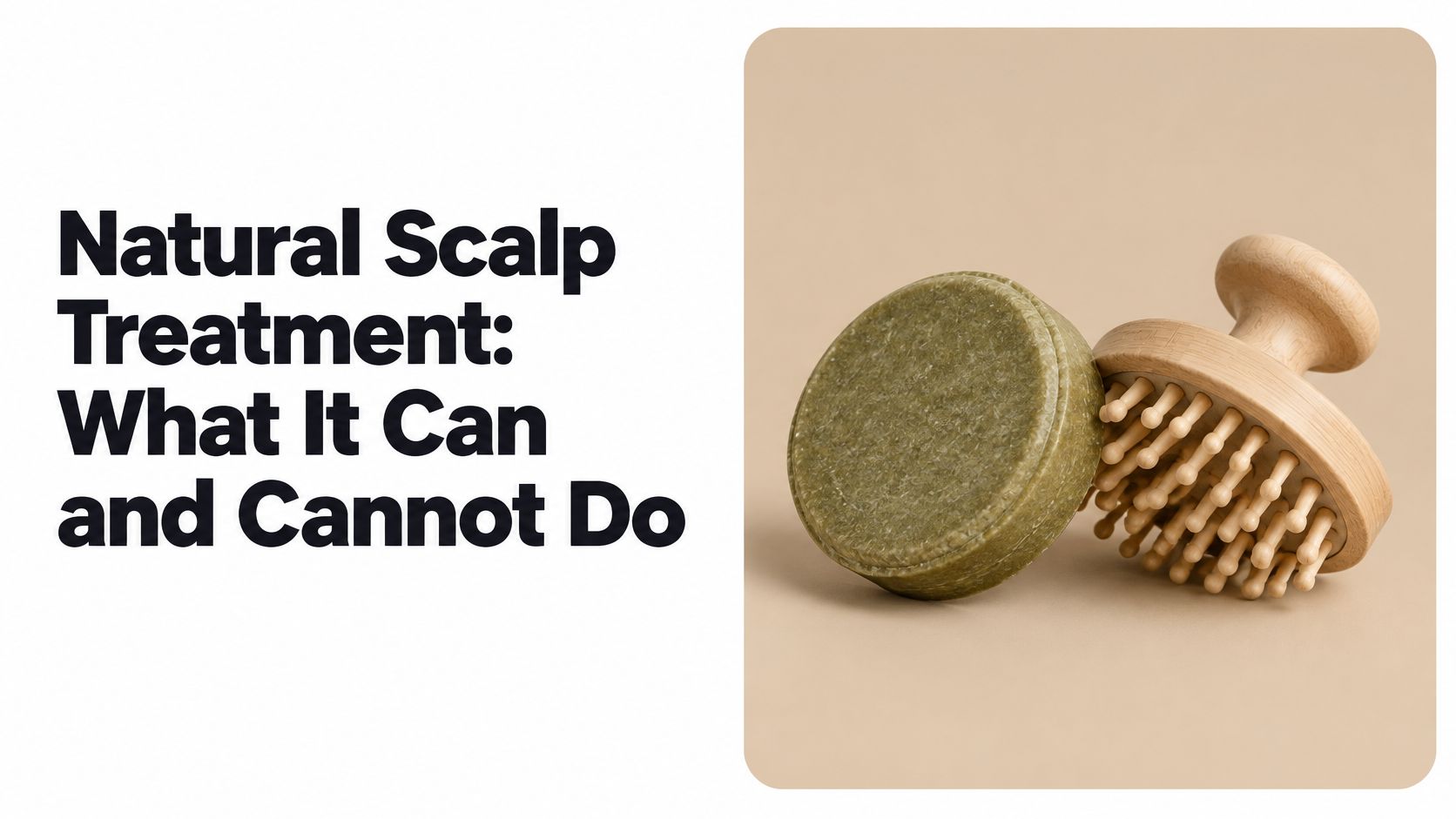
Adding rosemary oil or scrubbing away every flake isn't automatically the best natural scalp treatment. Before adding another botanical product, ask a simpler question: does your scalp need cosmetic care, or does it need medical evaluation? A pleasant scent and a freshly washed feeling can't answer that for you.
Plant-based cleansing, conditioning and massage can fit into a comfortable personal-care routine. A private head spa adds time, attentive touch and a quieter setting, but it shouldn't promise to cure inflammation or reverse hair loss. Understanding that distinction helps you choose care for what it offers.
Natural Scalp Treatment Options at a Glance
Natural scalp approaches, what they support and their limits
| Approach | What It Supports | What It Cannot Claim | Evidence Level |
|---|---|---|---|
| Gentle plant-based cleansing | Removes oil, sweat and product build-up | Does not treat a diagnosed scalp disease | Moderate for cosmetic tolerability |
| Botanical conditioning masks | Softens the scalp and hair lengths | Does not regrow hair | Limited, mostly ingredient studies |
| Gentle exfoliation | Loosens loose flakes and dead skin | Does not clear dermatitis or psoriasis | Limited, mostly practice-based |
| Scalp massage | Eases tension and supports relaxation | Does not treat hair loss | Limited, short-term comfort data |
| Essential oil blends in carrier oil | Adds scent and a sensory experience | Efficacy shown only for alopecia areata in one trial | Condition-specific, not general |
| Aromatherapy during a session | Supports short-term calm | Not a treatment for anxiety | Mixed, small trials |
Botanical scalp care is documented in Ayurveda, traditional Chinese medicine and Unani systems in a review of plant-based shampoo ingredients, but traditional use isn't clinical proof, a distinction that matters when assessing botanical evidence.
Choose the cosmetic job first
Read the table from the simplest task upward. Cleansing removes material from the scalp; conditioning changes how skin and hair feel. Neither task requires a promise about hair follicles, hormones or an underlying skin condition.
For example, if styling products leave your roots coated, a well-rinsed cleanse is a more direct starting point than adding a rich oil mask. If your hair lengths feel rough but your scalp feels comfortable, apply conditioner where the roughness is rather than assuming your scalp needs more product.
Exfoliation deserves particular restraint. The aim is to release already loose material, not to scrape the scalp until it feels exceptionally smooth. A soft scalp brush shouldn't become a tool for lifting attached scale.
Read evidence labels narrowly
The evidence labels describe different kinds of support, not a ranking of how luxurious an appointment feels. A formula can be pleasant to use without having clinical evidence for a disease claim. Likewise, a botanical ingredient studied in a particular formulation doesn't establish the performance of every product bearing its name.
Practical rule: Start with cosmetic layers such as cleansing and comfortable massage, change one thing at a time, and judge an otherwise comfortable routine over several weeks rather than after one session.
Don't use that observation period to tolerate worsening symptoms. A routine should remain comfortable while you assess it.
Which Scalp Symptoms Suit Natural Care and Which Need a Doctor
A 2024 systematic review and meta-analysis of 121 studies estimated a pooled global prevalence of 4.38% for seborrheic dermatitis. The same publication discusses an international questionnaire of 50,552 people reporting 3.3% overall, ranging from 1.2% in North America to 3.8% in East Asia.
Scalp concerns aren't unusual, but similar-looking flakes don't necessarily have the same cause. Use the following as a referral guide, not a diagnosis.
Scalp symptoms, what natural care can support and when to seek evaluation
| Symptom | Natural Care Can Support | Seek Professional Evaluation When |
|---|---|---|
| Light dryness or flaking, no redness | Gentle cleansing, moisture-focused routine, massage for comfort | Flaking lasts several weeks |
| Oily flakes with mild itch | Gentle cleansing, less layered product | Itch or scaling persists |
| Thick, greasy scale with redness | Cosmetic softening only | Any time; a dermatologist should assess it |
| Well-defined silvery scale | Not a home-care case | Always, because psoriasis is possible |
| Hair shedding or thinning | Keeps the scalp comfortable; does not reverse loss | Early in the process, before loss progresses |
| Burning, swelling, weeping or spreading rash | Stop all botanical products | Promptly, the same day where possible |
Notice persistence, not just appearance
Light flakes after a change in washing or styling don't give you enough information to name a condition. Start by noting what changed, which products touch your scalp and whether the skin feels comfortable between washes.
Say your roots look oily, so you add dry shampoo, then oil, then a scrub to remove both. Simplifying that sequence makes it easier to identify what you tolerate. It doesn't establish whether persistent scaling has a medical cause.
Attached scale, visible inflammation and repeated itching deserve more than a stronger cleansing session. A practitioner shouldn't scrub through discomfort to create a temporarily cleaner-looking scalp.
Keep separate concerns separate
Hair shedding changes the purpose of the appointment. You can still value gentle grooming, but a spa visit shouldn't delay assessment or become a test of whether massage will restore density.
Head pain also deserves its own consideration rather than being grouped with cosmetic scalp dryness. Our discussion of head massage for migraine distinguishes a comfort-oriented appointment from questions that belong with a healthcare professional.
Bring useful observations to an assessment: where symptoms occur, whether they spread, what you've applied and what made them worse. Photos taken under similar lighting can help you describe changes without repeatedly touching or scratching the area.
The key distinction is persistence, inflammation or hair loss. Once those are present, the question isn't which botanical ritual sounds most appealing. It's whether a qualified clinician should evaluate the scalp before you continue experimenting.
What the Botanical Evidence Covers and What It Does Not
A 2025 open-label, single-center shampoo study evaluated Ziziphus joazeiro bark and Apium graveolens seed extracts in 40 people with mild-to-moderate dandruff and sensitive scalps; after four weeks, skin water loss decreased 18.60%, redness decreased 22.8% and visible scaling decreased 29.23%. Those are promising short-term findings for the formulation tested, not proof that botanical shampoos are interchangeable.
Botanical studies, reported results and their limits
| Botanical Product or Review | Study and Population | Reported Result | Limit |
|---|---|---|---|
| Ziziphus joazeiro and Apium graveolens shampoo | Open-label, single-center study in people with dandruff and sensitive scalps | Reductions in water loss, redness and visible scaling | No conventional control group; short-term only |
| Thyme, rosemary, lavender and cedarwood oils in carrier oils | Seven-month randomized, double-blind trial for alopecia areata | Reported as safe and effective for that condition | Not shown for androgenetic alopecia, dandruff or dryness |
| Six shampoo plants: Acacia concinna, Camellia oleifera, Azadirachta indica, Emblica officinalis, Sapindus mukorossi, Garcinia mangostana | 2023 review of shampoo actives | Cleansing, conditioning, antioxidant and antimicrobial roles discussed | Does not establish treatment of a diagnosed disease |
A whole formula is more than its headline ingredient
In the shampoo study, participants and investigators knew what product was being used. Without a conventional-control group, the findings can't establish how much better that shampoo performed than another suitable cleanser.
Reduced water loss is a measurement related to skin barrier function. It isn't a measurement of hair regrowth, and less visible scaling doesn't establish that an underlying condition has been treated.
The shampoo-ingredient review describes possible roles for plants within formulations. Antioxidant or antimicrobial activity isn't automatically a demonstrated benefit on a person's scalp. The concentration, preparation, contact time and finished formula all matter.
A condition-specific result stays condition-specific
The essential-oil trial used thyme, rosemary, lavender and cedarwood diluted in jojoba and grapeseed carrier oils, with daily massage. The carriers, application method and duration were parts of the intervention, not optional details that can be discarded when discussing the result.
A bottle of rosemary oil used occasionally isn't the same intervention. Nor does a finding involving alopecia areata establish a result for hereditary pattern thinning or routine scalp dryness.
Match the claim to the condition, formula and method studied. Treat anything beyond that evidence as cosmetic comfort, not an established treatment.
For a head spa, this creates a useful boundary. A practitioner can describe careful cleansing, product texture and the experience of touch without converting a published trial into a promise about your appointment. Evidence about an ingredient isn't evidence about every service using botanicals.
How to Patch-Test a Botanical Scalp Product
A home product check is a precaution, not a guarantee against allergy and not the same as diagnostic patch testing by a dermatologist. A 2024 review of essential oils in scalp dermatitis describes sparse clinical evidence, small samples and limited information about long-term effects.
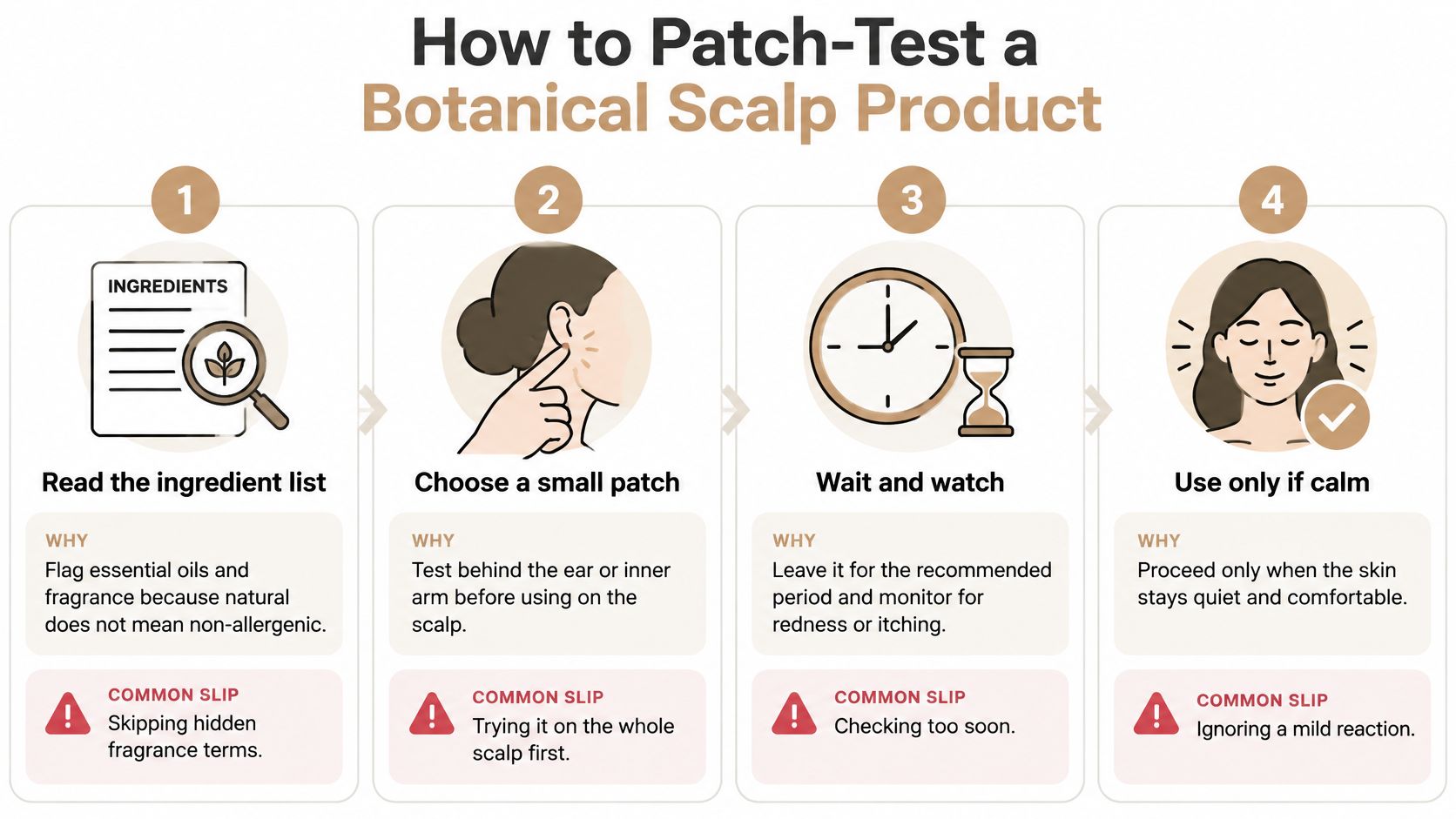
Use this visual as an overview, then follow the product-specific precautions below.
Check the product before the scalp
Read the complete ingredient list. Flag essential oils, fragrance and anything associated with a previous reaction, because natural doesn't mean non-allergenic. A common slip is checking the featured plant on the front while overlooking the rest of the formula.
Choose a small area of intact skin on the inner forearm or behind the ear, following the manufacturer's testing instructions. Don't test on broken, irritated or inflamed skin, and don't use your whole scalp as the first test area.
Use the intended dilution. For an essential-oil preparation, use a documented dilution in a suitable carrier and never apply neat essential oil. Guessing with extra drops makes the preparation harder to assess and can increase irritation risk.
Apply a small amount using the product's intended contact method. A leave-on product may remain for its specified test period, but rinse-off shampoo must be rinsed as directed, not left on as an improvised overnight test.
Watch for delayed changes. Check at 24 and 48 hours, or according to the manufacturer's instructions, for redness, itching, swelling or bumps, and note when anything appears. Checking immediately and assuming you're finished can miss a later response.
Only if the area remains comfortable, introduce a light scalp application as directed and observe your response over several days before increasing use. A clear small-area test doesn't guarantee that repeated use or a larger application will be tolerated.
Stop if burning, swelling or worsening itch develops. Rinse away the product when appropriate and seek medical advice for a significant or persistent reaction. Don't cover the reaction with another botanical preparation to try to soothe it.
Tingling isn't a success signal
Burning or pronounced tingling isn't proof that a product is stimulating follicles or doing useful work. It's a reason to stop and assess what your skin is telling you.
Adding more ingredients can make a reaction harder to trace. If you introduce a scented shampoo, an oil blend and an exfoliant together, you won't know which product caused the change, and continued exposure may worsen irritation or sensitization.
Safety boundary: A negative home test isn't permission to apply botanicals to an actively inflamed scalp.
Keep the packaging or a clear ingredient-list photo so you can identify exactly what you used. A professional treatment should document its ingredients and essential-oil dilution so you can review them before your first session.
Sensory Rituals and What Aromatherapy Can and Cannot Offer
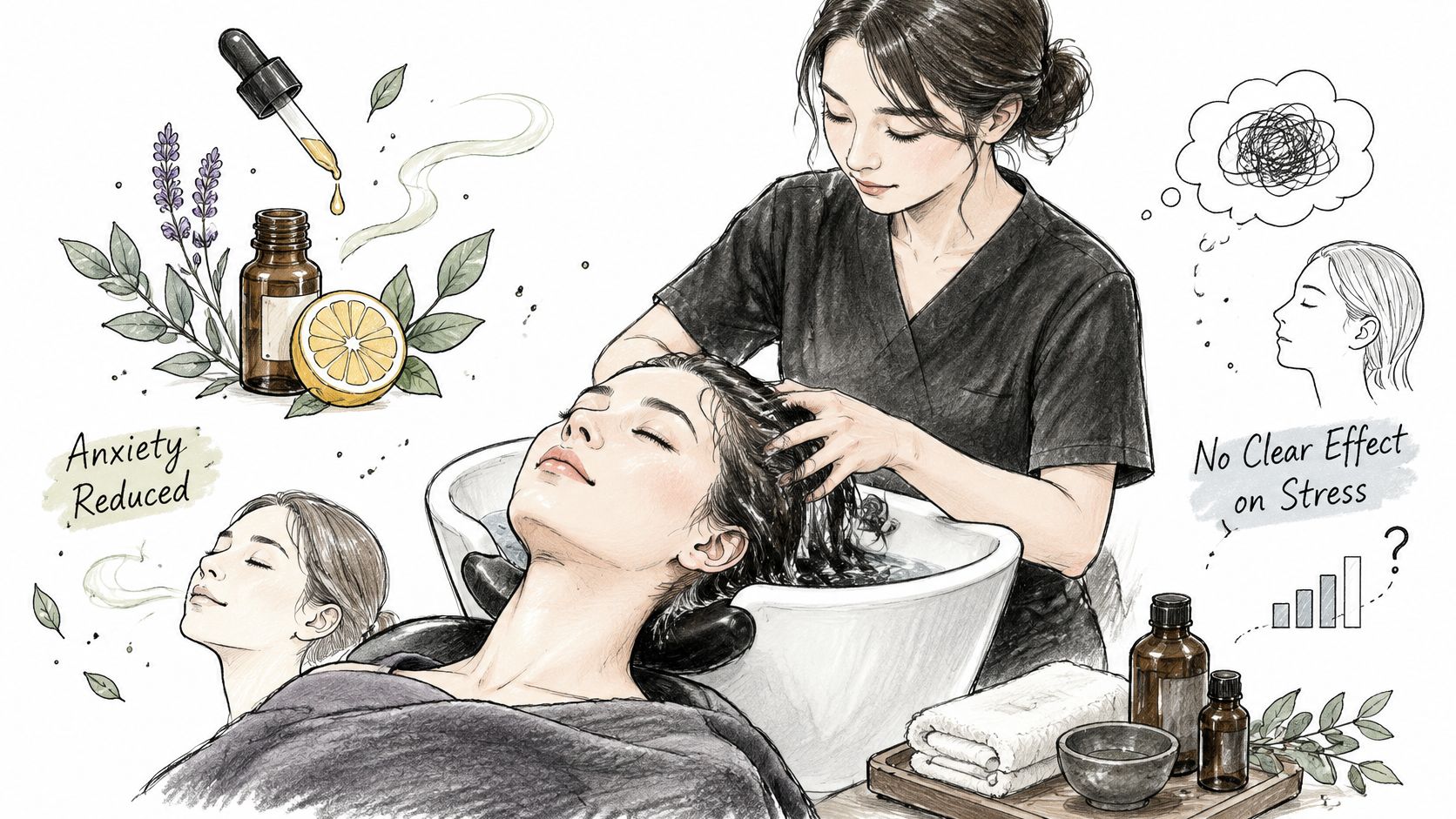
A 2025 systematic review of aromatherapy in student populations found a statistically significant reduction in anxiety, but no significant effects on stress, pulse rate, respiratory rate or academic performance. That mixed result doesn't justify promising a medical or psychological outcome from a head spa appointment.
The image below illustrates hands-on scalp care, not a guaranteed anxiety outcome.
Describe what you'll experience
A sensory ritual can combine the scent of plant-based products, a quiet room, gentle sound, guided meditation and massage. Closing with tea gives you an unhurried transition before returning to your day. These are concrete features you can choose because you enjoy them.
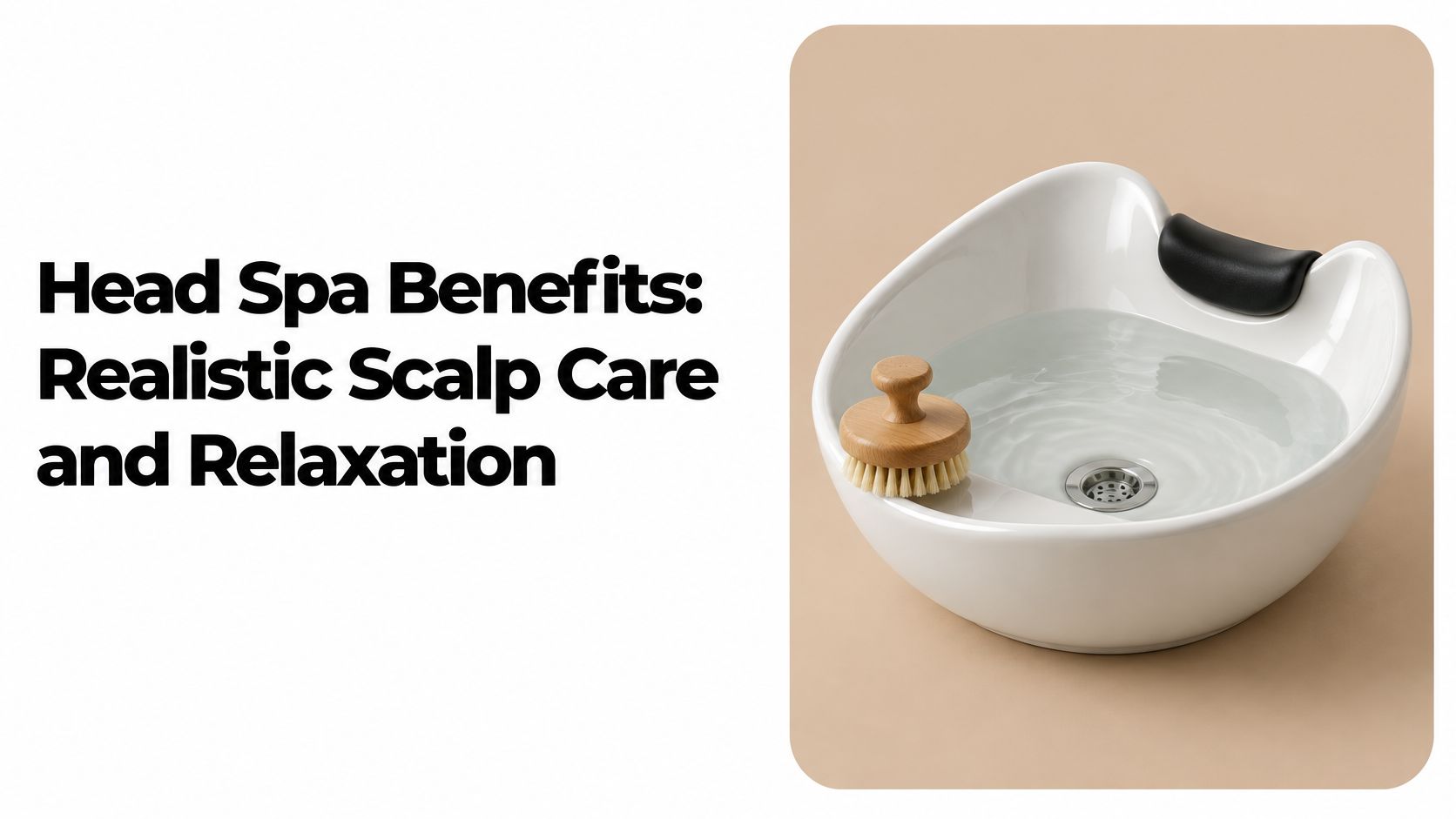
At Inner You, we use natural, plant-based products and a Japanese headspa bowl as part of our private head spa setting. The bowl and waterfall sequence shape the physical experience of receiving scalp care; they aren't evidence of a medical effect.
| Comfort-first description | Claim to avoid |
|---|---|
| A calm, scented pause | Relieves anxiety |
| A private way to enjoy scent and touch | Cures stress |
| Gentle care for a freshly cleansed feeling | Treats an inflammatory scalp condition |
| Personal attention in a quiet setting | Guarantees emotional or physical change |
Our guide to choosing an aromatherapy spa experience offers another way to think about scent as a preference within a visit, rather than its medical purpose. A stronger fragrance isn't a measure of a better appointment.
This video offers a visual sense of a head spa ritual.
Privacy changes the experience, not the evidence
A private room gives you space to say that a scent feels overwhelming or that you'd prefer less conversation. You don't have to compare your reactions with those of someone receiving care beside you.
That freedom can be part of luxury without requiring an exaggerated outcome. Comfort, personal attention and relaxation are appropriate descriptions of the intention behind the setting. Diagnosis, prevention and treatment aren't descriptions of what a sensory spa ritual provides.
What a Private Botanical Head Spa Session Looks Like
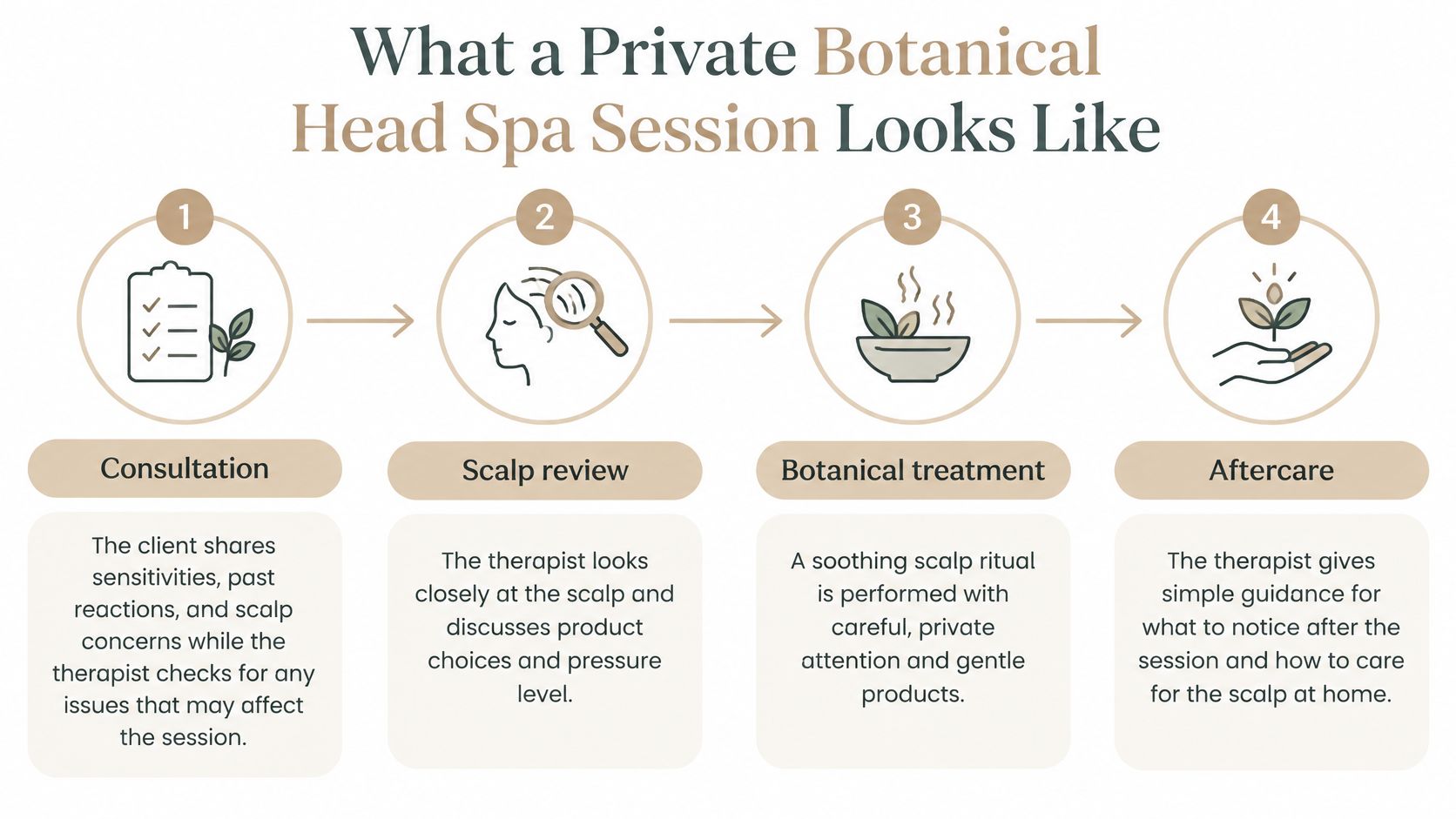
A private botanical session should feel understandable before you settle into the chair. The following timeline describes the stages to discuss, with the exact treatment elements determined by your booking and suitability.
The visual outlines the broad flow from conversation to aftercare.
Before water or products
Consultation. You share your scalp concerns, sensitivities and previous product reactions before any application. This is also the time to mention recent changes in your routine and any discomfort that could make a cosmetic session unsuitable.
Settling in. Our standard appointments serve one guest at a time rather than placing you in a shared treatment area. You can explain preferences privately, whether that means less conversation, lighter touch or more time to get comfortable.
Botanical scalp cleanse. The Inner Hour ritual uses Oway botanical care for its scalp brush cleanse. Cleansing should be controlled and comfortable, with the brush used to work product through the scalp rather than scrape attached flakes.
Through the hands-on ritual
Head massage. Tell the practitioner what pressure feels comfortable and speak up if that changes. The service name therapeutic head massage describes a massage element of the ritual, not a promise to treat a medical condition.
Rinse and gentle exfoliation. Rinsing removes loosened residue without requiring forceful rubbing. Where exfoliation belongs to the selected treatment, it should remain gentle rather than becoming an attempt to remove every visible scale.
Sensory layer. Aromatherapy and sound accompany the physical care as experiential elements. You don't need to feel a particular emotion or achieve a meditative state for the appointment to be worthwhile.
For readers unfamiliar with bowl-based cleansing, our explanation of a hair washing spa describes how washing can become a more attentive personal-care experience.
Finishing without rushing
Drying and styling. The finish follows the service you've booked. Mention any sensitivity to heat or pulling so the handling remains comfortable, and don't assume every ritual includes a full styling service.
Tea reflection. Where included, the closing tea provides a pause to notice how you feel before leaving. You can use that time to identify any area that feels uncomfortable and discuss what products touched your scalp.
Privacy matters in practical ways: you can ask for a pause without feeling that you're interrupting another guest, and you can discuss a concern without a shared room listening. The luxury is undivided attention and room to communicate, not a more forceful treatment.
Afterwards, your scalp may feel freshly cleaned or mildly warm. Lasting redness, itching or burning shouldn't be treated as an expected sign of effectiveness. Report it to the provider, compare the products used with your test notes and seek medical advice when symptoms warrant it.
Choose a Session Length and Book Your Visit
Check suitability first. Compare your symptoms with the referral guide before booking. If you have inflammation, unexplained shedding or a reaction, arrange appropriate medical evaluation before choosing a cosmetic ritual.
Review product tolerance. Complete an appropriate small-area product check before a full application, and mention previous reactions when arranging your visit.
Choose the time and care you want.
- Inner Hour Head Spa Ritual, 1 hour, $169. Includes aromatherapy, therapeutic head massage, scalp brush cleanse with Oway botanical care, waterfall therapy, guided meditation, sound therapy, express blow-dry and tea reflection.
- Renewal, 1 hour 30 minutes, $229. Includes head massage, scalp exfoliation, hair treatment, face spa, décolleté and hand massage, guided meditation, aromatherapy and sound therapy.
- Face + Body, 2 hours, $329. A combination for relaxation and renewal.
Preview the environment. Watch our treatment footage on TikTok or Instagram to see the room, bowl and treatment pacing. A social-media video overview highlights video's role in how people explore content; for your booking, the useful question is whether the visible setting suits your preferences.
Reserve your appointment. We take bookings through Square or by text at our private studio at 4622 Van Nuys Boulevard, second floor, suite 9, Sherman Oaks. Include sensitivities when booking so they're part of the conversation before treatment.
Choose the length that fits your goal, confirm that your scalp suits gentle cosmetic care, then reserve your visit.
Inner You offers private head spa rituals that pair botanical scalp care with a Japanese headspa bowl and an unhurried sensory setting. For a natural scalp treatment focused on comfort rather than medical promises, visit Inner You to choose your appointment and share your preferences before you arrive.