Head Massage Oil: How to Choose, Apply and Clean Up
Learn how to choose, apply and clean up head massage oil safely, with scalp-type guidance, dilution rates and when to skip oil.
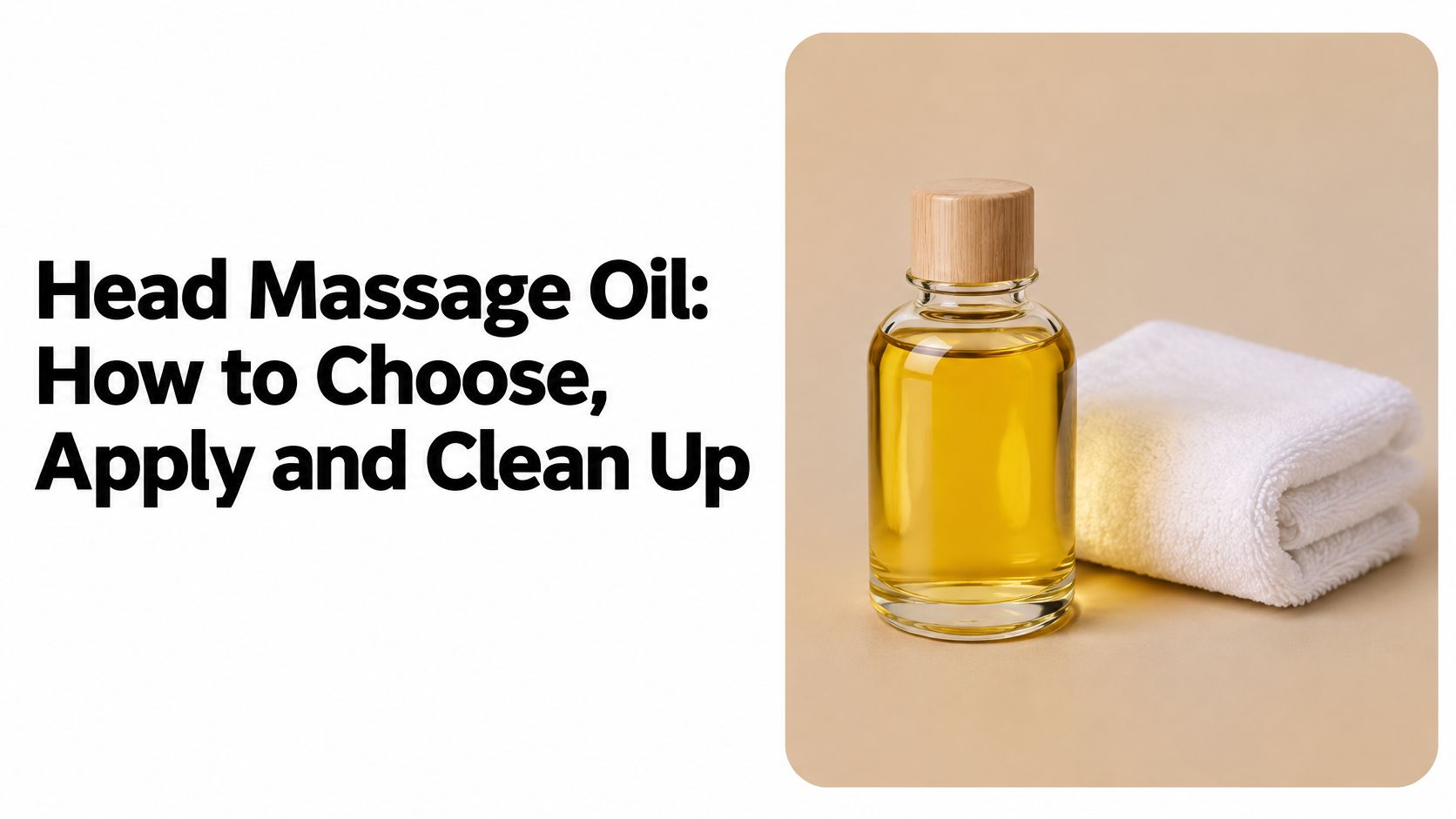
The most popular advice about head massage oil is also the least useful: warm some oil, work it into your scalp, leave it overnight, and repeat often. That routine suits some dry, coarse hair. For an oily scalp, fine hair, or sensitive skin, it can leave buildup, heavy lengths, and itching that has little to do with relaxation.
Oil isn't required for a good head massage. It's a variable to adjust, like pressure, timing, and scent. Sometimes a light carrier oil helps your fingertips glide and protects fragile lengths before washing. Sometimes the better choice is lengths only, or no oil at all. At Inner You, we treat that choice as part of comfort and privacy, not as a medical treatment, and the same thinking works at home.
Choose the Right Oil for Your Scalp and Hair
Start with placement, not brand names. A carrier oil is the base that gives your fingertips slip, such as jojoba, grapeseed, sweet almond, sunflower, or coconut oil. An essential oil is a concentrated scent ingredient used in drops, never as the main liquid. Confusing those two roles leads to most of the heavy, irritated results people blame on head massage oil itself.
| Scalp or hair type | Suitable carrier oil | Where to apply | Watch for |
|---|---|---|---|
| Dry scalp, coarse or curly hair | Coconut oil | Lengths and ends first, light on the scalp | Heavy residue; shampoo twice |
| Dry scalp, fine hair | Jojoba oil | Thin layer at the roots only | Can weigh fine hair down |
| Normal scalp, any hair type | Sweet almond or grapeseed oil | Light scalp massage, then lengths | Small amounts prevent buildup |
| Oily or flaky scalp | None on the scalp | Mid-lengths and ends only | Oil on the scalp can accumulate and attract yeast |
| Bleached, chemically treated or sun-exposed hair | Coconut oil | Lengths and ends before washing | Keep light on fine strands |
| Sensitive or eczema-prone skin | Plain jojoba or sunflower oil | Patch test first; no essential oils | Fragrance can trigger irritation |
Dry hair that can handle a richer oil
Coarse, curly, and porous hair usually tolerates coconut oil better than fine hair does, especially when you concentrate on the lengths and ends and keep the scalp layer light. Coconut oil has a specific reason for this place in the table. In the PubMed comparative study of coconut, sunflower, and mineral oils, coconut oil was the only oil that consistently reduced protein loss from both undamaged and damaged hair when used before or after washing, and it reported approximately a 44% reduction in wet-combing-related damage for undamaged hair.
That finding is about the hair shaft, not the follicle. Coconut oil's lauric-acid triglyceride structure has high affinity for hair proteins, low molecular weight, and a relatively linear chain that enables penetration into the hair shaft. Practically, that makes it a pre-wash option for bleached, chemically treated, sun-exposed, or otherwise porous lengths. It doesn't make it a proven treatment for hair loss, and using more won't strengthen the effect. Excess increases cleansing demand.
Fine hair and normal scalps need restraint
If your scalp feels dry but your hair is fine, jojoba in a thin layer at the roots only is easier to control than coconut oil worked through everything. You get slip for massage without coating strands that collapse under weight. For a normal scalp, sweet almond or grapeseed oil in light amounts does the same job with less risk of a greasy finish the next morning.
I would start smaller than you think you need. You can add a few drops during the massage if your fingertips drag. You can't easily remove a heavy application without starting the wash early.
Practical rule: Choose the oil for the hair you have to wash out, not just the scalp you want to massage.
Sensitive skin gets the simplest formula
For sensitive or eczema-prone skin, plain jojoba or sunflower oil with no essential oils is the conservative starting point, and you should patch test first. Fragrance is optional. Comfort isn't. A scented blend that leaves you checking for itching for two days has failed, even if it smelled pleasant for ten minutes.
Before you buy or mix anything, answer three questions. Is your scalp oily, dry, flaky, or fairly neutral by the second day after washing? Is your hair fine and easily weighed down, or coarse and porous? Do you have known fragrance, nut, or skin sensitivities that rule oils in or out? Match those answers to one row, use that row's placement, and ignore advice written for a different head of hair.
When Head Massage Oil Does More Harm Than Good
The most common mistake is adding oil to a scalp that's already oily, flaky, or coated in styling residue, then leaving it there longer when flakes don't improve. For some people, the best scalp oil is none. That's not a failure of technique. It's the correct adjustment.
The Canadian Dermatology Association hair care guidance advises avoiding direct scalp oil application because oil can accumulate and attract yeast. WebMD also notes that olive oil may worsen dandruff by creating a more favorable environment for fungi, and that evidence for plant-oil home remedies is sparse. If your scalp is already producing enough oil, another layer doesn't balance it. It sits on top.
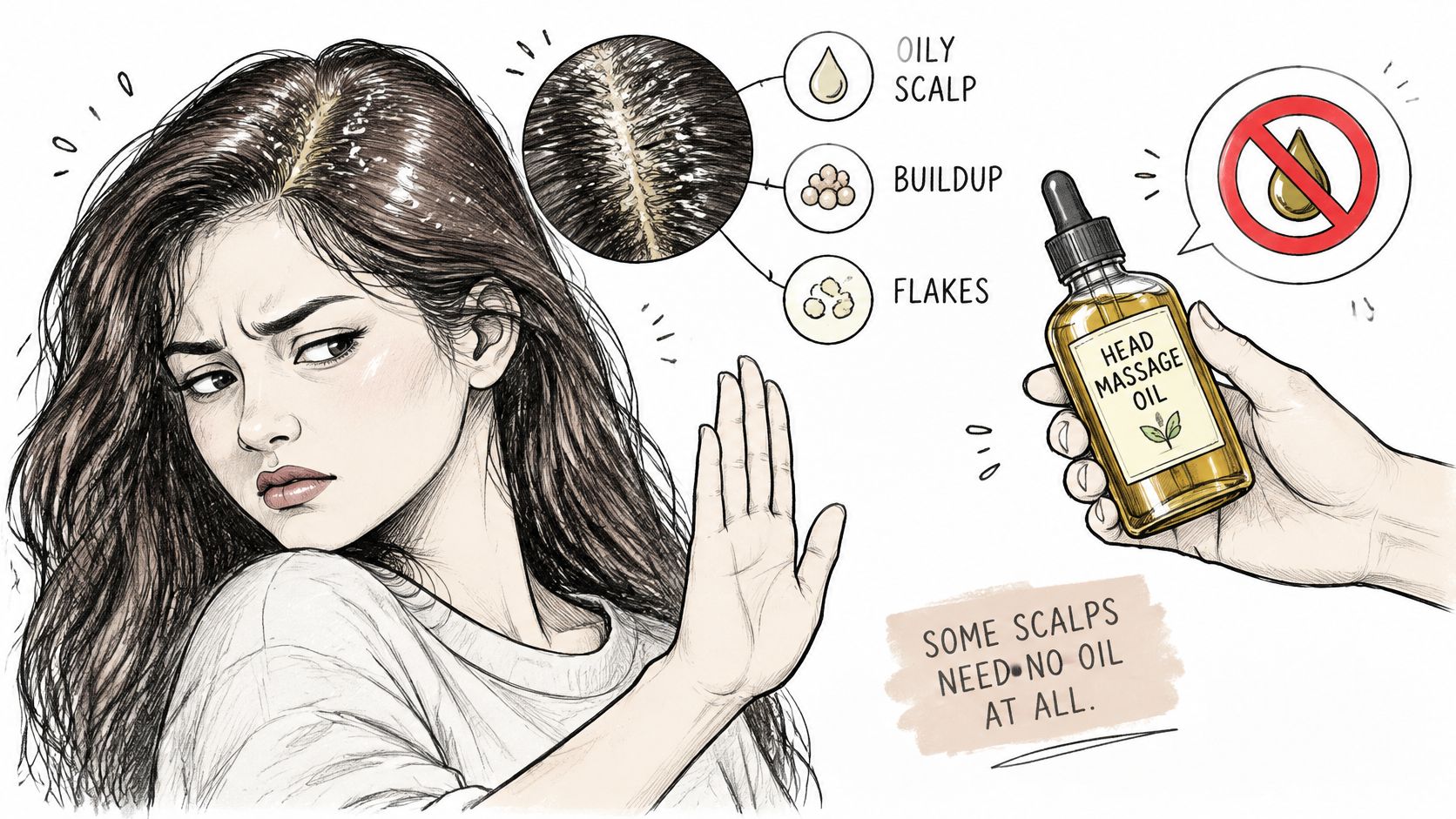
Scalps where oil should stay off the skin
Keep head massage oil off the scalp when you recognise these patterns:
- Visible buildup or oiliness: Your roots look heavy within a day, or your fingertips pick up residue when you scratch lightly.
- Flaking with itching: Flakes paired with an oily scalp or suspected seborrheic dermatitis don't need an overnight oil soak.
- Acne-prone scalp or hairline: Bumps along the forehead, nape, or parting often get worse when oil lingers.
- Fine or straight hair: Oil travels readily along straight strands, so residue shows quickly and lengths look separated.
In those cases, oil only the mid-lengths and ends if they're dry, and keep your fingertips on the scalp dry. You'll still get pressure, rhythm, and warmth from your hands. Much of the relaxing part of a head massage comes from gentle, steady touch and an unhurried ritual, not from the liquid itself.
What a dry massage still gives you
A dry scalp massage removes cleansing problems entirely. There's no residue to emulsify, no pillowcase to protect, and no uncertainty about whether a new blend caused itching. Use slower movements than you would with oil, because dry fingertips create more friction, and lift and reposition your hands instead of dragging them through tangled roots.
If you have to wash twice, check for irritation, and change the pillowcase, the oil didn't make the ritual simpler or more restful.
Stop experimenting and seek medical evaluation for persistent redness, odor, pain, or sudden or patchy hair loss. Oil isn't a treatment for any of those, and rotating through coconut, olive, and castor oil only delays a proper look at what's happening. The same applies when flaking spreads, sores appear, or itching keeps you awake. A calmer decision is to massage dry, keep products simple, and let a clinician handle symptoms that don't settle.
Dilution Rates, Patch Tests and Who Should Avoid Essential Oils
Essential oils earn their place in a blend through scent, and scent works at low concentrations. If you are comparing options for a natural scalp treatment, check the dilution before you debate lavender versus rosemary, because no essential oil belongs on the scalp undiluted.
| Dilution | Drops per 30 ml carrier oil | Suitable for | Notes |
|---|---|---|---|
| 0.5% | 3 drops | Sensitive scalp or first-time users | Start here for any new blend |
| 1% | 6 drops | Everyday scalp massage | Common low range for routine use |
| 2% | 12 drops | Adults with tolerant skin | Use only if 1% causes no reaction |
| 3% | 18 drops | Short sessions for adults | Ceiling; avoid near the eyes and for children |
| Undiluted (neat) | Not applicable | None | Not recommended; can cause sensitization |
I start every first-time blend on the top row and move to a stronger row only after a clean patch test.
Why the low range matters
DermNet guidance on allergic contact dermatitis to essential oils warns against applying neat, undiluted essential oils directly to skin, because sensitization can occur and delayed allergic contact dermatitis shows up as itching, redness, and scaling. Expert safety summaries add irritant dermatitis, phototoxicity from some citrus oils, and folliculitis to the list of possible reactions, and recommend low-percentage dilution with patch testing before routine use.
Concentration changes the risk in a concrete way. A Tisserand Institute safety review reports that topical tea tree oil used at 5% or 10% carries an estimated real-world adverse-reaction risk of approximately 0.01% to 0.1%, while clinical testing produced allergic reactions in 2% of participants at 25%, 6% at 50%, and 8% at 100%. Those numbers belong to tea tree specifically. The wider lesson holds anyway: "natural" is not a dilution plan.
One often-cited trial deserves a careful reading. A small randomized study in people with alopecia areata found more regrowth in a group massaging thyme, rosemary, lavender, and cedarwood diluted into jojoba and grapeseed carriers every day for months than in a group using the carrier oils alone. A single small trial, one specific diagnosis, and a long daily routine say little about ordinary shedding or general scalp health. Treat essential oils as diluted sensory ingredients, and let the carrier oil do the massage work.
A 48 hour patch test
Mix the blend at exactly the strength you plan to use on your scalp. Place one diluted drop on the inner forearm or behind the ear, cover it lightly if needed, then leave the area alone. Check at 24 hours and again at 48 hours for itching, redness, swelling, or scaling, because allergic reactions can be delayed.
A clear test site tells you more than the label on the bottle.
On darker skin tones, early inflammation can be harder to recognize by colour alone. Feel for warmth, raised texture, tightness, and itch, and compare the spot with nearby skin in good light. If anything changes, keep that blend off your scalp even when the reaction looks mild.
Who should skip essential oils or ask first
Stick with a plain carrier oil, or check with a clinician first, if you have eczema or fragrance sensitivity, you are pregnant, the oil is for a child, strong scents trigger migraine for you, or medication makes your skin more reactive. There is no benefit to pushing through warning signs for the sake of scent.
If burning or itching starts during a massage, stop, wash the area with mild soap and water, and leave it uncovered rather than layering a second product over the sensation. Switch to a plain carrier next time, or massage dry. At a studio appointment, mention allergies and fragrance sensitivities when you book, so the options can be talked through before anything is blended.
How to Apply Head Massage Oil Step by Step
Good application is mostly portion control and patience. Start with about one teaspoon for short or fine hair, add small amounts only if your fingertips drag, and use no more than a few tablespoons even for long, thick hair. Once or twice a week is enough for many people. Daily oiling usually creates a cleansing problem faster than it creates a better ritual.
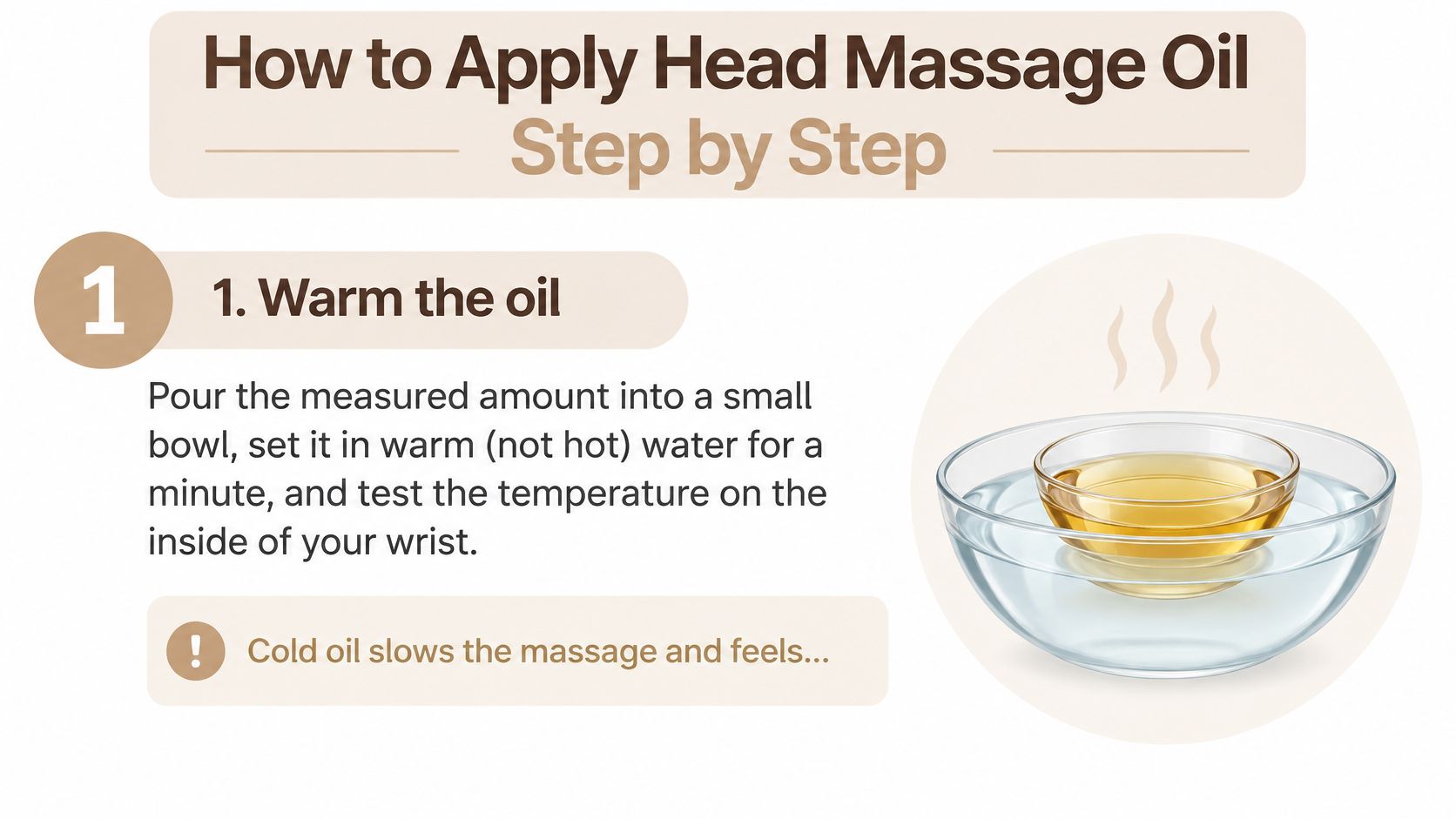
The seven steps
Warm the oil gently: Pour the measured amount into a small bowl, set it in warm, not hot, water for a minute, and test a drop on the inside of your wrist. Cold oil feels tight and spreads poorly. Don't microwave it, because hot spots are easy to miss until the oil reaches your scalp.
Section before you pour: Clip dry hair into four parts so oil reaches parting lines instead of coating only the surface. If your hair is short, create a few informal partings with your fingers. Skipping this step is why people end up with greasy lengths and an untouched scalp.
Apply in small drops: Place drops along each parting and spread them with the pads of your fingertips, never your nails. Add oil section by section rather than tipping the bowl over your crown. Fine hair needs restraint at this stage, because excess won't disappear during the massage.
Massage with firm, slow circles: Start at the temples and hairline, move over the crown, then finish at the sides and nape for five to ten minutes. Keep pressure steady enough to move the scalp slightly over the skull, not so hard that you pull roots. If your arms tire, shorten the session instead of speeding up into a scrub.
Decide how far down the lengths to go: Work remaining oil through dry, coarse, curly, bleached, or sun-exposed lengths if the table points you there. If your hair is fine, stop at the mid-lengths and use only what's already on your hands for the ends. If your scalp is oily or flaky, skip scalp application entirely and keep this step lengths only.
Rest for 20 to 30 minutes: Cover your hair with a warm towel or cap and use the time to sit down, not to start chores that make you sweat. Overnight oiling isn't automatically better. It increases buildup, transfers oil to bedding, and makes the wash longer, especially with coconut oil.
Begin the rinse correctly: Before you flood your hair with water, work a little shampoo and a splash of water through the oiliest areas to emulsify the oil, then lather and rinse fully. Repeat only if your hair still feels coated. A good finish is specific: your scalp feels clean, your roots lift away from each other, and there's no slick film when you run clean fingertips through dry hair.
Quantity check: If oil drips onto your forehead or shoulders, you've used more than a massage requires.
Adjust one variable at a time. If the result feels heavy, reduce the amount before you change oils. If scent irritates you, remove essential oils before you abandon massage. If lengths feel dry but roots look greasy, move placement down the strand. Those small corrections teach you more than buying a new bottle every week.
Cleaning Up Oil Without Residue or Stains
Cleanup decides whether you'll repeat the ritual. Oil left on roots attracts dust, makes fine hair separate, and can make a scalp that felt comfortable during massage feel coated by the next morning. The goal isn't to strip your hair. It's to remove the massage layer completely while keeping the wash calm. If you prefer a guided wash to doing this over your own sink, a hair washing spa visit handles the rinsing for you.
The wash sequence
- Wipe first: Blot excess oil from your hands, forehead, ears, and hairline with a dry towel you don't mind staining. This stops oil spreading onto your face in the shower.
- Shampoo dry hair first: Massage shampoo directly into oiled roots before adding much water, so it can break down the oil instead of sliding over it.
- Add water slowly: Work in a little lukewarm water, build a lather through the scalp and lengths, then rinse thoroughly.
- Repeat only where needed: Coarse, curly, or heavily oiled hair often needs a second shampoo. Fine hair usually needs one careful wash, and a second can leave it feeling squeaky and flyaway.
- Condition with intention: Put conditioner on mid-lengths and ends, not on a scalp you've just cleaned, unless the product is specifically made for scalp use.
Use lukewarm water, since very hot water can leave the scalp feeling dry and tight. Coconut oil needs one extra detail: it can solidify in cool water, so run the shower warm for a moment before you rinse and keep the water comfortably warm while the oil leaves the drain.
Towels, pillowcases, and the final check
Pre-treat oil marks on towels and pillowcases with a drop of dish soap, rub it in lightly, then wash on a warm cycle. Don't put an oil-stained item in the dryer until the mark is gone, because heat makes the stain harder to lift. A dedicated old towel for oil days saves your better linen.
Do a 30 second check once your hair is dry. Your scalp shouldn't feel slick, roots should move freely when you shake your head, and your fingertips shouldn't come away shiny. The next morning, your pillowcase should be clean. If it isn't, use less oil next time or shorten the rest period. Cleaner removal usually comes from a smaller starting dose, not a harsher shampoo.
Private Head Spa Versus Oiling at Home
At home, you control the oil, the scent, and the timing. You also handle sectioning with tired arms, guess at dilution, wash your own hair, and pre-treat the towel. That trade-off is fine when you enjoy the process. A booked session makes sense when you'd rather recline, keep your hands still, and leave the rinsing and cleanup to someone else. If you're comparing options for a head spa near me, weigh privacy, process, and what each appointment includes.
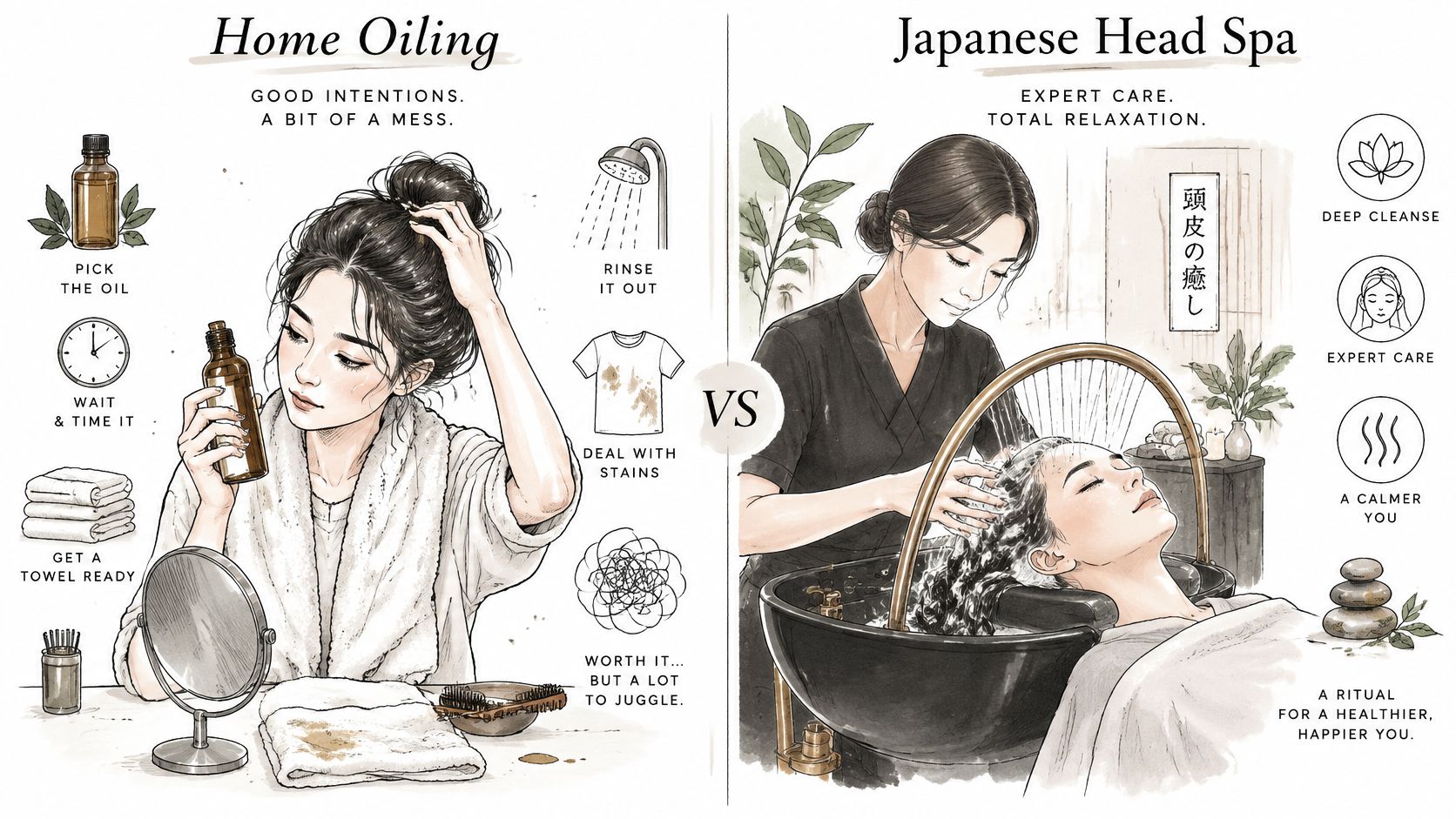
At Inner You, standard appointments serve one guest at a time in a private studio, so you aren't sharing the room with another customer's conversation or treatment. That structure offers discretion, quieter surroundings, and uninterrupted attention. On Sundays, our paired format lets two guests visit together while receiving different services concurrently, one head spa and one body massage, and both men and couples can book. The choice is operational: private retreat or coordinated outing.
A head spa appointment follows a set sequence: a scalp brush cleanse with Oway botanical care, waterfall therapy sending warm flowing water across the scalp, therapeutic head massage, aromatherapy, guided meditation, and sound therapy. The session finishes with an express blow-dry and a tea reflection. The point is comfort and relaxation, with oiling, rinsing, and cleanup handled for you.
You can preview the room and water-flow sequences before you book in this video:
You'll also find treatment videos on our TikTok profile at @inner_you_la and Instagram profile at @inner_you_la, which show the setting and rituals in video format. Our Inner Hour Head Spa Ritual is one hour for $169 and includes therapeutic head massage, a scalp brush cleanse with Oway botanical care, aromatherapy, waterfall therapy, guided meditation, sound therapy, an express blow-dry, and tea reflection. We're at 4622 Van Nuys Blvd, 2nd floor, suite 9, Sherman Oaks, CA 91403.
Whichever setting you choose, use the same checklist. Match carrier oil and placement to your scalp and hair type, keep oil off an oily or flaky scalp, keep essential oils diluted and patch tested, and tell the studio about allergies before the session starts. That's how head massage oil stays a comfort choice instead of becoming another product problem.
If you'd like the oil choice, warm waterfall rinsing, and cleanup handled for you in a private, luxury setting, visit Inner You to book a one-guest head spa appointment in Sherman Oaks. Tell us about your scalp type, hair texture, and any fragrance sensitivities when you reserve, and we'll shape the session around comfort, quiet, and uninterrupted attention.