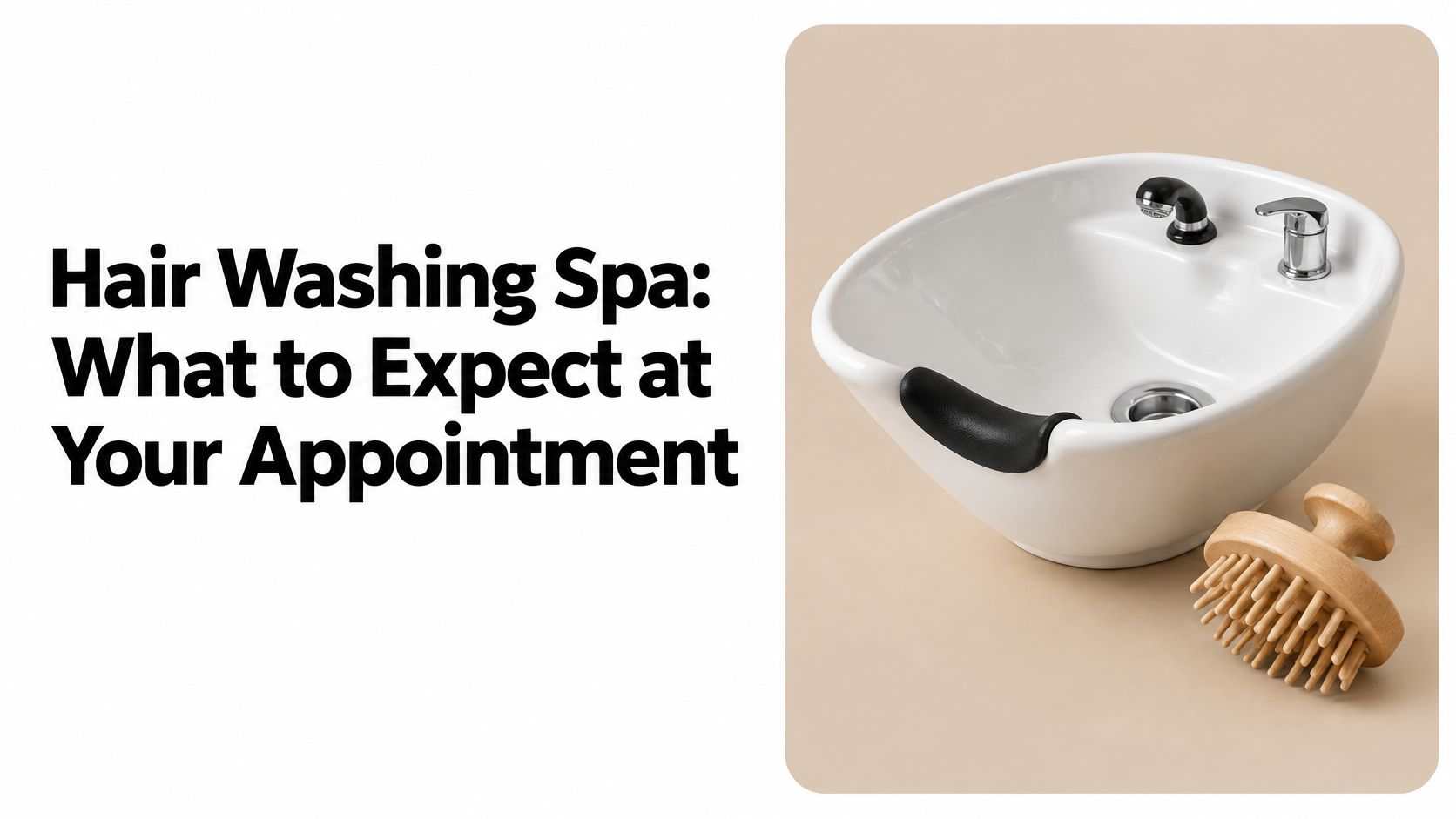
Hair Washing Spa: What to Expect at Your Appointment
A hair washing spa session explained: the steps, how often to wash your scalp, what it can and cannot do, and how to book a private visit.
Your roots feel oily, your ends feel dry, and your shoulders are still raised after a long day. A regular shampoo would get your hair clean, but you're looking for something less hurried. Then you see a hair washing spa video and wonder what happens beyond the flowing water and scalp massage.
A hair washing spa combines cleansing and hair care with a slower, sensory appointment. The useful distinction is between what cleans your scalp and what makes the visit comfortable. Neither luxury nor relaxation requires a promise to treat a scalp condition.
What Happens During a Hair Washing Spa Session
At Inner You, our private and luxury head spa in Sherman Oaks, standard appointments welcome one guest at a time. You don't have to settle into a shared treatment room or carry on a conversation while someone nearby receives another service. The appointment starts with attention to your preferences, rather than immediately turning on the water.
Say you arrive with long, colour-treated hair and tenderness near your temples. During the consultation, tell your practitioner how your scalp feels, when you last had colour or chemical services, and where touch feels uncomfortable. Those details help guide product selection, handling and pressure.
The process illustration gives a broad view of the visit.
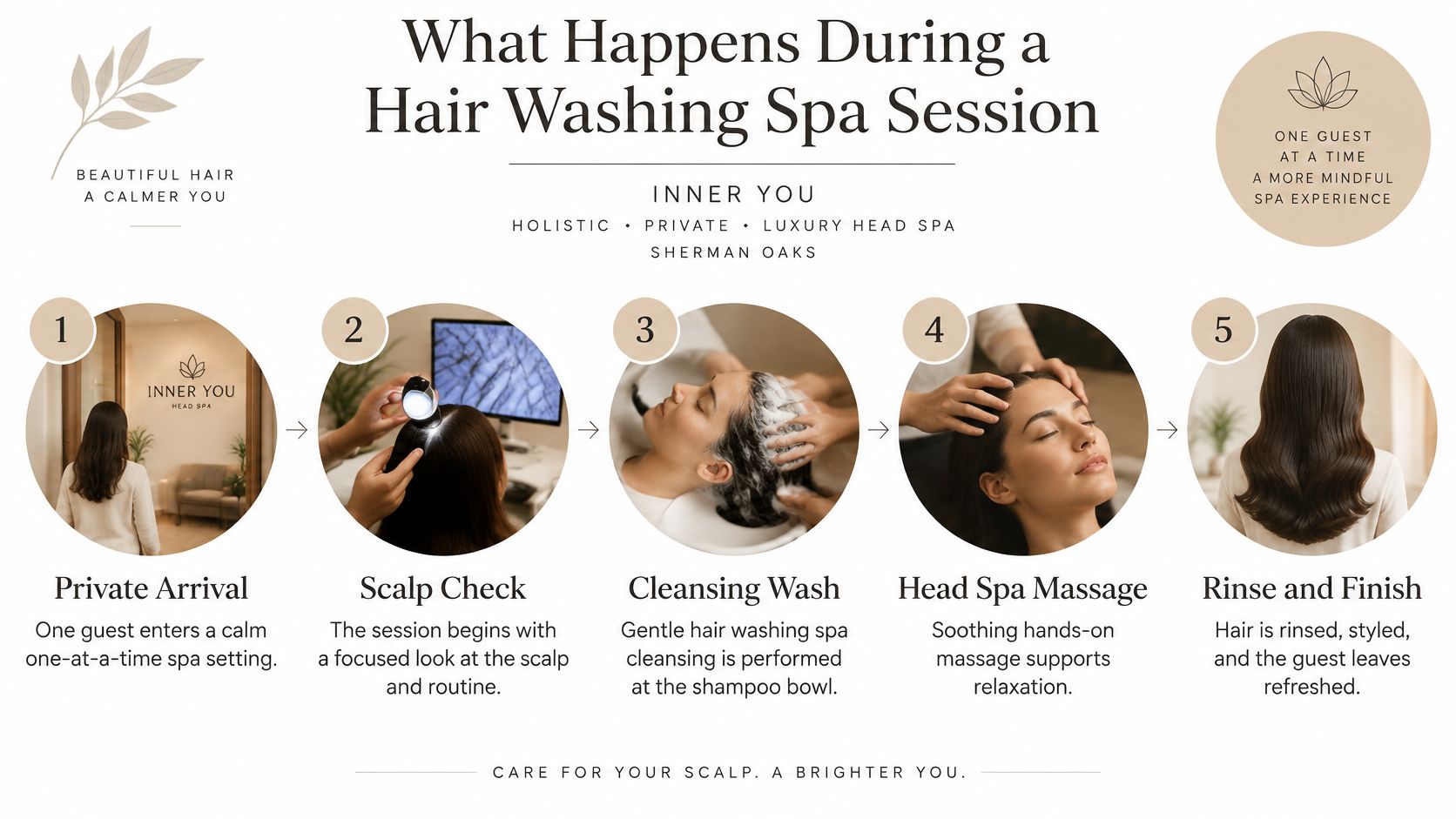
From arrival to the finishing ritual
Stages of a private hair washing spa session
| Stage | What Happens | Why It Matters |
|---|---|---|
| Consultation | Practitioner asks about scalp feel, hair length, past colour or chemical services and any tenderness | Sets pressure and products to the guest |
| Seated head and neck massage | Slow, moderate-pressure work on neck, shoulders and scalp | Settles the body before cleansing |
| Scalp cleansing | Cleanser applied with fingertip pads, brush where suitable | Removes sebum, sweat and product residue |
| Rinse and conditioning | Warm rinse, then conditioner on the lengths | Limits friction and keeps hair manageable |
| Sound and meditation | Guided breathing with sound and aromatherapy | Supports a quiet, immersive pace |
| Drying and tea reflection | Towel dry or express blow-dry, then a tea ritual | Closes the session in a calm, unhurried way |
The seated massage offers a gradual transition from arriving to resting. Moderate pressure doesn't mean pressing through discomfort. Our guide to hair and scalp massage explains the role of deliberate, comfortable touch.
At the bowl, the practitioner works across the scalp rather than scrubbing the hair into a tangled pile. A brush is an option where suitable, not a requirement for a successful wash. Rinsing clears the cleanser before conditioning addresses the lengths.
Breathing guidance, sound and a chosen aroma create pauses around the hands-on care. Drying or an express blow-dry provides a practical finish, while tea reflection gives you space before returning to your day.
Cleansing is the practical base. Massage, scent, sound and quiet make the appointment feel different from a rushed home wash.
A session is going well when your scalp feels clean without tightness, pressure stays comfortable, and you can ask for a change in temperature or touch at any point.
Who a Head Spa Suits and When to See a Clinician First
A head spa is a wellness appointment. It involves relaxation and routine scalp care, which is distinct from diagnosing or treating a symptom. Think of the difference between a car wash and a mechanic: both involve the same machine, but only one is equipped to find out why something is wrong. Before booking, decide which of the two you need.
Consider your current scalp condition, not just the result you hope to see.
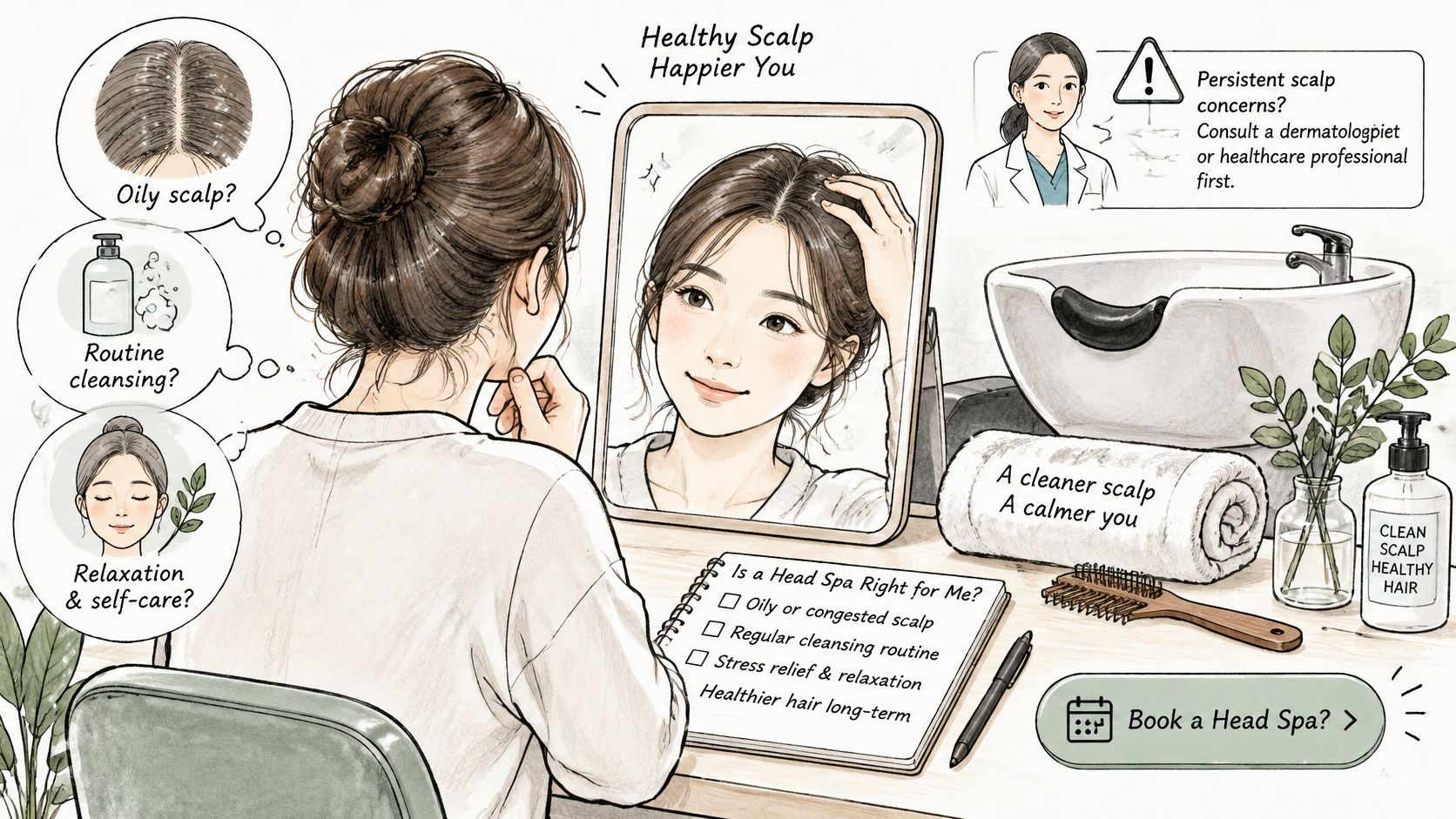
Even basic product roles can be confusing. Many people are unsure whether shampoo belongs mainly on the scalp or conditioner mainly on the lengths. Knowing that distinction helps you describe what feels oily, dry or uncomfortable during a consultation, which gives the practitioner a clearer starting point.
Choose the right kind of appointment
Suitability by scalp and hair situation
| Situation | Suits a Wellness Head Spa? | See a Clinician First? |
|---|---|---|
| Routine cleansing, tension or a lightly oily scalp | Yes | No, unless symptoms persist |
| Persistent itching, flaking or dandruff | Discuss with the practitioner first | Yes, if it continues after washing changes |
| Scalp sores, open wounds, infection or active inflammation | No | Yes, before booking |
| Sudden or patchy shedding | Not as a treatment | Yes |
| Scarring hair loss or thinning at the hairline or front | No, not as a treatment | Yes, see a dermatologist |
| Recent scalp procedure, chemical service or sensitive scalp | Yes, with pressure and products adjusted, after any required clearance | Yes, if irritation follows |
A spa cannot treat dandruff, seborrheic dermatitis, scarring hair loss or sudden shedding. An itchy, flaking scalp deserves discussion before hands-on care, and clinical evaluation if it continues after changes to washing. A scalp check during a consultation isn't a diagnosis.
For another visual perspective on head-spa care, you can watch this video.
A quiet reset fits someone with ordinary product buildup and no concerning symptoms. A painful patch or unexplained hair loss calls for a different starting point. If a symptom is new, painful, spreading or getting worse, see a clinician before booking. Once a clinician has ruled out anything that needs treatment, a head spa can return to doing what it does well: keeping a healthy scalp clean, calm and cared for.
Preparing for Your Visit and Caring for Your Scalp After
You usually don't need to wash your hair before a hair washing spa appointment. Cleansing takes place during the service, so an extra-heavy wash or layers of styling product beforehand are unnecessary. Follow any individual preparation instructions we give you, especially after a recent chemical service or scalp procedure.
Ordinary, lived-in hair is fine. You don't need to make it unusually clean, and you shouldn't deliberately let buildup accumulate for the appointment.
Before you arrive
- List recent services. Note colour, perming, relaxers and scalp treatments so the consultation can account for them.
- Skip heavy styling products that day. Wax, thick oils and firm-hold sprays add material that must be removed before direct scalp contact.
- Choose an easy-to-undo hairstyle. A loose arrangement makes access simpler without unnecessary pulling.
- Arrive a little early. Leave room for an unhurried conversation before treatment begins.
- Mention tenderness immediately. Don't wait until pressure becomes uncomfortable to explain that an area is sensitive.
Also tell your practitioner about braids, hijab use, chemical processing and any medication relevant to your scalp or skin. Describe your normal routine rather than trying to guess which details matter.
Let comfort guide aftercare
If your scalp feels clean and comfortable, keep your usual washing schedule. If it becomes oily or product-heavy, washing within a day is reasonable. If it feels tender or flaky, choose a gentle product, use lukewarm water and pause exfoliation rather than adding another intensive step.
Aftercare rule: Don't scratch the scalp or repeat exfoliation to chase a cleaner feeling. More friction isn't a better finish.
Don't expect detoxification or hair growth from a single session. Persistent or worsening itching, flaking, sores or sudden shedding calls for a clinician, not another spa booking.
Why Scalp Cleansing Is More Than a Rinse
Cleansing isn't only about making hair look fresh. The scalp is skin, and a wash must address what sits on that skin without treating the lengths as though they have the same needs. Oil near the roots and dryness at the ends can exist together.
A review of scalp cleansing and shampoo science describes surfactants removing sebum, sweat, environmental particles, scale and styling residue, and reports significant reductions in scalp surface and pore sebum after a single wash with a shampoo containing 0.5% piroctone olamine. That finding belongs to the tested formulation. It doesn't establish the same result for every botanical or non-medicated cleanser.
Excess oil and retained residue can contribute to follicle blockage and conditions such as seborrheic dermatitis and folliculitis in some people. That explains why cleansing matters, but it doesn't turn a cosmetic wash into treatment for those conditions.
Match the technique to the scalp
A practitioner should consider oiliness, visible scale and product accumulation alongside hair porosity and chemical-treatment history. For example, oily roots don't justify rough handling of bleached lengths. Cleansing intensity and hair handling are separate decisions.
- Place cleanser on the scalp. Part or move the hair as needed so the product reaches the skin rather than sitting on the outer layer of hair.
- Use fingertip pads, never nails, with controlled contact instead of scratching.
- Distribute before rinsing. Work across the scalp so attention isn't concentrated only at the crown.
- Avoid hard rubbing. Comfortable movement is more useful than trying to create an aggressively scrubbed feeling.
- Condition the lengths. Focus on areas that need slip and easier detangling, rather than automatically coating the scalp.
The role of conditioning is different from cleansing. Our explanation of a deep-conditioning hair spa helps distinguish care for the hair fibre from care directed at the scalp.
Clean doesn't mean stripped
The shampoo and conditioner review in the International Journal of Trichology explains that overly aggressive removal of sebum can leave hair dry, frizzy or difficult to manage. A squeaky feel isn't a useful target if the hair becomes rough and tangled afterward.
A good cleanse is matched to the scalp in front of you. The goal is appropriate removal, thorough rinsing and manageable hair, not maximum foam or maximum friction.
How Often Your Scalp Needs a Wash
Match your washing interval to your scalp rather than borrowing someone else's schedule. Everyday habits differ widely: in YouGov Profiles data collected in April 2022 across eight markets, adults agreeing that they washed their hair daily included 26% in France, 30% in Britain, 41% in the United States, 50% in Saudi Arabia, 54% in India and 67% in Singapore, according to YouGov. Those are descriptions of behaviour, not recommended frequencies.
Newer findings also resist a universal rule: the scalp-washing evidence discussed in this clinical publication includes a 2025 survey of 300 people in which 59.85% washed twice weekly, 30.12% once weekly and 7.3% adjusted frequency by hair type; a 2025 study of 60 women wearing hijab found greater scalp water loss with washing every 1–2 days than every 3–5 days, without a significant difference in scalp hydration.
Less frequent isn't automatically better, either. The same evidence discussion includes Cleveland Clinic guidance that some people may need washing two to three times weekly to limit inflammation and yeast overgrowth, alongside a 2025 case-control study associating washing once weekly or less with higher odds of frontal fibrosing alopecia. An association doesn't establish that infrequent washing caused the condition or that more washing prevents it.
Try a two-week observation method
Use this as a practical tracking exercise, not a diagnostic test.
- Start with a familiar interval. Avoid changing products and frequency together, which makes the results harder to interpret.
- After each wash, record itching, flaking, odour and oiliness as absent, mild or bothersome.
- Shorten by a day if flaking or odour increases, provided washing itself remains comfortable.
- If tightness or dryness rises, try a longer interval and review cleanser strength rather than scrubbing harder.
- Bring your notes to a practitioner or clinician if symptoms persist.
Your curl pattern, styling practices and scalp comfort all belong in that conversation. A spa appointment can complement your routine, but it doesn't replace a workable home-washing schedule.
Scent, Sound and Stillness in a Private Ritual
The sensory part of a head spa isn't an extra cleansing mechanism. It's the part that lets you stop monitoring your phone, following conversations around you or wondering when you need to move. In a private room, you have more room to be quiet without feeling that you must entertain anyone.
At Inner You, the sensory setting includes custom aromatherapy made with essential oils, gentle vibrations and harmonic tones, and guided meditation. You can express preferences about scent, sound and verbal guidance. Luxury here means attention to comfort and pace, not the strongest fragrance or the most elaborate equipment.
Privacy changes how the appointment feels
A one-guest setting removes shared-room conversation from the experience. You can close your eyes, ask for less talking or take a pause without negotiating the atmosphere with other guests. Our guide to an aromatherapy spa experience explores how scent fits into that setting.
Controlled studies offer context, not a prediction for your visit: a randomized trial of 78 shift nurses over one week reported perceived-stress score decreases of 11.08 points with music, 10.77 points with aromatherapy and 3.15 points with the usual routine. A systematic review of aromatherapy for stress found a favourable pooled estimate but cautioned that the trials were few, small and generally at high risk of bias. Neither establishes that a head spa produces those results or treats anxiety or another condition.
You don't have to achieve a particular state of relaxation for the appointment to be worthwhile.
Instead of looking for a measurable transformation, notice what's comfortable:
- Scent: Is the aroma pleasant, or would you prefer less?
- Sound: Does the rhythm feel unobtrusive enough to rest with?
- Breathing: Does your breath become easier or slower without forcing it?
The most honest description is also the most useful: a quiet, immersive and comfortable ritual, with room for individual preferences.
Book a Private Head Spa Session in Sherman Oaks
A private head spa appointment works best when you know what you want from it. Routine scalp cleansing, an hour that isn't rushed, the quiet of a room booked for one guest: any of those is reason enough, and none needs framing as a problem to fix.
The fit is clearest for readers who want:
- A relaxing scalp-care ritual built around thorough washing, massage and release from everyday tension.
- A one-guest setting, where privacy and personal comfort shape the whole appointment.
- An honest line between wellness and medicine: persistent flaking, soreness or unusual shedding belongs with a clinician first; the session itself is rest and routine care.
The studio is upstairs in suite 9 on Van Nuys Boulevard, in a building with a hair salon on the ground floor. Men and couples are both welcome, and on Sundays the paired format gives one guest the head spa while the other receives a body massage. First visits come with a $30 gift.
Have these details ready
Before you book, settle on your main goal, note any scalp symptoms worth mentioning, and list recent colour or chemical services. Choose a time that lets you arrive without rushing, so the hour starts calm.
Sessions combine careful hair washing with massage, aromatherapy, sound and a closing tea ritual. Book through the Square booking page or text (323) 716-3338 to arrange a private visit at 4622 Van Nuys Blvd, 2nd floor, suite 9, Sherman Oaks, CA 91403.