Deep Conditioning Hair Spa for Scalp and Hair
See what a deep conditioning hair spa includes, how it complements scalp and hair care, and how a private room adds comfort.
The most popular advice about dry, dull hair is simple: add more moisture, leave it on longer, and put it everywhere. That advice sounds generous, but it's often wrong. A rich mask can make your lengths feel softer while sitting heavy on roots that needed a cleanse instead. A deep conditioning hair spa works best when you stop treating hair and scalp as the same surface. You're booking time, careful hands, and a calmer way to coat the hair fiber, not a cure for whatever your scalp is doing that week.
What a Deep Conditioning Hair Spa Really Is
Say it's a weekday shower at home. You shampoo, squeeze out water, smooth conditioner through the ends, wait while you wash your face, and rinse. That quick coat is useful. It gives you slip, so a comb moves with less snagging, and it leaves hair easier to handle until the next wash.
A deep conditioning hair spa stretches that same basic idea into a guided visit. Someone else handles the cleanse, applies a richer treatment in sections, leaves it on while you rest, adds head massage, rinses with care, and finishes your hair in a quiet room. You're not buying a different kind of magic. You're buying longer contact time, even application, and comfort you don't get standing in a shower.
Think of wiping your shoes at the door versus sitting down while someone cleans, conditions, and buffs the leather. The first habit keeps things presentable day to day. The second is slower, more thorough, and partly about the experience itself. Your home conditioner stays the regular habit either way.
What changes when it becomes an appointment
Three things change significantly. First, time: an intensive treatment remains on your hair instead of rinsing away in a minute or two, allowing the coating to spread evenly. Second, hands: a practitioner can work product through mid-lengths and ends in small sections, including the back layers often missed at home. Third, setting: you recline, the room stays quiet, and massage fills the waiting period instead of you scrolling with wet hands.
That setting matters more than marketing usually admits. A private room means you aren't listening to the next guest's conversation or watching a busy floor while you're trying to rest. The pace slows down. The rinse is unhurried. For many guests, that unhurried hour is half the reason to book.
- At home: a fast coat after shampoo that supports your normal routine
- In a spa: a timed treatment, massage during the wait, and a careful finish
- In both cases: a temporary surface coating that improves feel and combing
The honest boundary
Name the limit before you book. This is grooming plus relaxation. It can leave hair softer, shinier looking, and easier to detangle for a while. It doesn't rebuild split ends, reverse thinning, or diagnose why a scalp feels sore or flaky.
That boundary does not make the visit less valuable. It aligns your expectations with what you'll notice in the mirror and under your fingers. If your ends feel rough, your hair tangles the moment it's wet, or you want a private hour where someone else does the careful work, you're describing exactly what this kind of appointment is built for. If something on your scalp hurts, spreads, or won't settle, that's a different conversation with a different professional.
What Each Step in the Session Does
Use the table as your map for a deep conditioning hair spa. Each row is something you can see or feel during the visit, paired with a result the step doesn't claim.
Deep conditioning hair spa steps and what they change
| Step | Where it works | What you can notice | What it does not do |
|---|---|---|---|
| Cleanse | Hair and scalp surface | Residue lifts so treatment can spread | Does not treat dandruff or hair loss |
| Gentle scalp exfoliation | Scalp surface | Lighter feel around the roots | Does not clear scaling, inflammation, or shedding |
| Deep conditioning mask, 20–30 minutes | Mid-lengths and ends | Softer feel, more slip, fewer tangles for a while | Does not rebuild split ends or internal bonds |
| Head massage | Scalp, neck, and comfort | Even spread and a calmer wait | Not a medical or stress treatment |
| Moderate warmth | Suitable hair fiber | Easier product spread | High heat can dry chemically processed hair |
| Careful rinse, blot, and finish | Fiber surface | Shine without roughing the cuticle | Not a permanent seal or repair |
Cleanse and optional exfoliation come first
The cleanse lifts styling residue, oil, and loose debris so the treatment can reach hair instead of sliding over buildup. You're starting with a clean surface, the same reason you'd wipe a table before polishing it. Where a spa offers gentle exfoliation, it stays on the scalp surface and works as a surface refresh around the roots. It isn't a fix for scaling or soreness, and a good practitioner keeps pressure light and stops if your skin feels reactive.
The mask and the wait
Next comes the mask through mid-lengths and ends, where older, drier fiber usually needs the most slip. Head massage often runs alongside application or during the wait. It helps spread product, and it turns processing time into rest instead of dead time. That's a comfort feature, and it's fine to value it as one.
Moderate warmth can help product move across hair that tolerates it. High heat is a poor match for color-treated or chemically processed hair, so warmth should feel gentle, never like a hot styling tool parked on your head. If your hair is fragile, ask for no added heat. The treatment still coats the surface without it.
Why slip matters so much
Hair weathering wears away the cuticle's outer lipid seal, including 18-methyl-eicosanoic acid, so the fiber takes up water more readily, tangles faster, and breaks more easily under a comb, as explained in a review of hair fiber surface science. In a controlled grooming study described there, applying conditioner before detangling reduced grooming-related hair damage by up to 82%, because lubricated strands slipped past each other instead of grinding.
That's the whole mechanism in plain terms. Conditioning agents, polymers, oils, and proteins settle onto the charged, damaged surface, lower friction between strands, and calm static. Your comb needs less force. Less force means fewer snapped ends during detangling, especially on wet hair that's at its most stretchy and vulnerable.
Practical rule: detangle only when hair is saturated and slippery, starting at the ends, and never drag a brush through dry tangles before a treatment.
The rinse protects what the mask just did. A practitioner rinses with low friction, blots with a towel instead of rubbing, and finishes with a simple dry or blow-finish. Rubbing wet hair with a rough towel would roughen the surface you just smoothed. Walk out expecting temporary reinforcement and easier combing, not rebuilt ends or new internal bonds. Keep the rich product on your lengths as the default, because the scalp follows different rules.
When the Mask Belongs on Hair Not the Scalp
Hair and scalp share the same stretch of skin, so marketing loves to blur them. Resist the blur. A conditioning mask works like lotion for the shaft: it coats, softens, and lubricates. It does that job well. What it cannot do is reverse shedding, treat dandruff, or repair an irritated scalp.
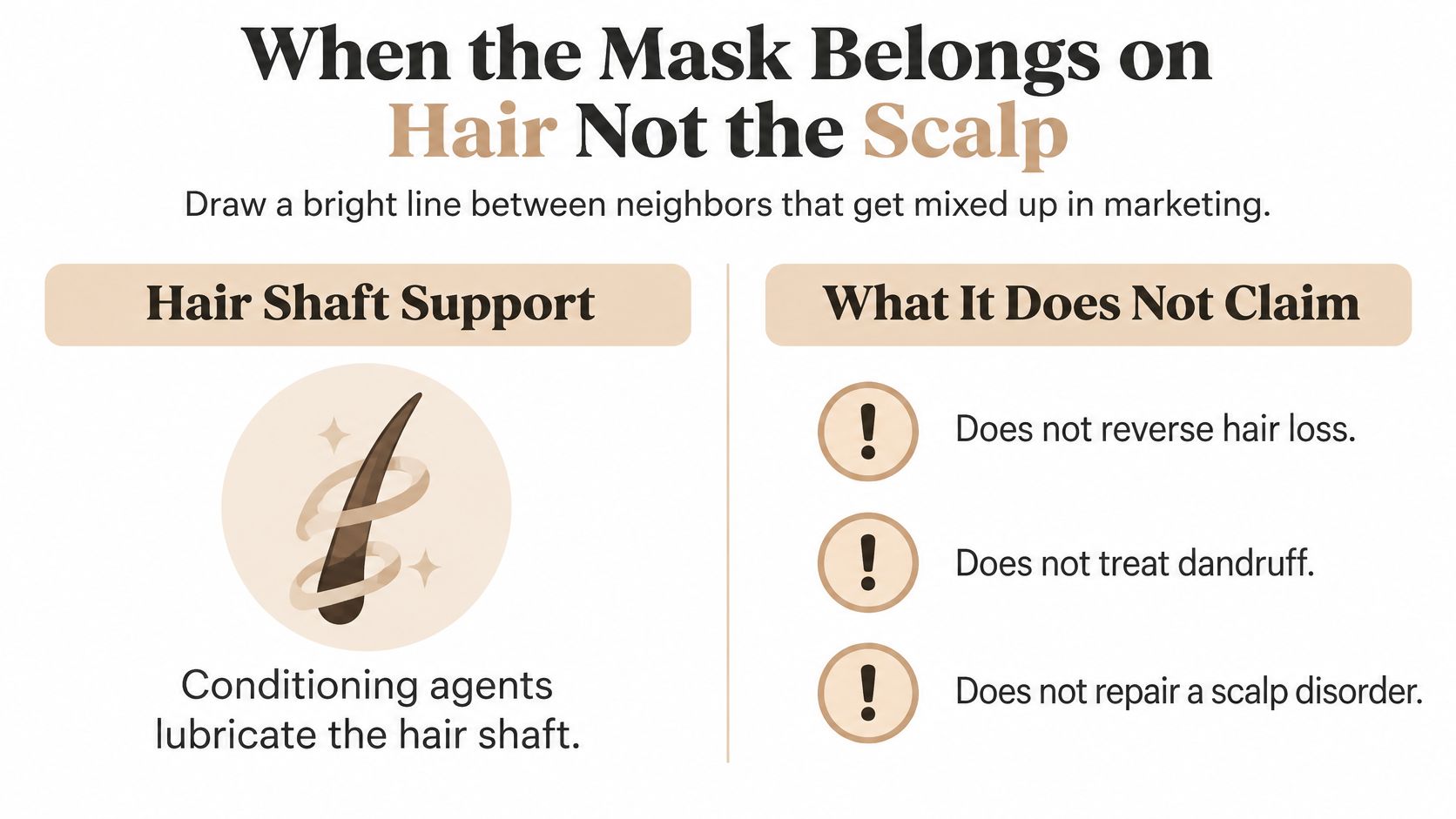
The split matters because scalp worries drive a large share of hair care bookings. Concerns about scalp health and hair thinning sit near the top of what clients say they want help with, and those worries are real. They are also different problems from dry ends. A conditioning mask is built for the dry ends, and booking a richer mask or a longer session does not change which problem gets addressed.
More moisture isn't automatically better scalp care
Say your roots feel heavy by evening and your ends feel like straw. One product everywhere can't serve both surfaces. A rich mask left on for a while suits very dry lengths and ends, especially around chemical processing. The same cream massaged into your scalp can flatten fine hair, leave oily roots looking dirtier, and sit on skin that needed a proper cleanse first.
A scalp-leaning visit flips the emphasis. The practitioner focuses on careful cleansing or light exfoliation at the roots and keeps heavy oils and masks off the skin. Your lengths might get a lighter conditioner so you don't trade weighed-down roots for parched ends, or the reverse. Placement is the skill you're paying for. The richest formula in the room won't help if it lands on the wrong surface.
Where to place care by hair and scalp goal
| Goal | Place the care | Avoid | Sensible next step |
|---|---|---|---|
| Very dry lengths or ends | Rich mask on mid-lengths and ends for 20–30 minutes | Skipping the ends and coating only the roots | Home mask or a hair-focused spa |
| Fine or oily hair | Light conditioner on the ends only | Heavy mask or oil on the scalp | Cleanse, then a light finish |
| Product buildup at the roots | Gentle cleanse or light scalp exfoliation | Occlusive oils left on the scalp | A scalp-cleansing visit, not a heavier mask |
| Persistent shedding, scaling, pain, or suspected alopecia | No cosmetic mask as treatment | Using a spa in place of assessment | Medical care, with grooming only as comfort |
Reading the table like a booking decision
Match your row before you choose a service name. Dry ends point you toward a hair-focused deep conditioning hair spa. Buildup at the roots points toward cleansing first. Fine hair calls for restraint at the scalp, however dry the ends feel. Each row keeps you from paying for intensity in the wrong place.
The last row carries the most weight. Persistent shedding, inflammation, scaling, pain, or suspected alopecia belongs with a clinician who can examine your scalp and ask about your history. A spa visit can still be a comfortable grooming appointment alongside that care if your clinician sees no reason to avoid it. It can't stand in for the assessment itself.
A conditioning treatment can make hair feel softer without explaining why the scalp itches.
Hold that line while you compare menus. If a service promises to fix your scalp by adding a richer cream for longer, ask where the product goes and what it's meant to coat. A clear answer about placement tells you more than any ingredient list printed in gold.
Ingredients and Warmth That Suit the Fiber
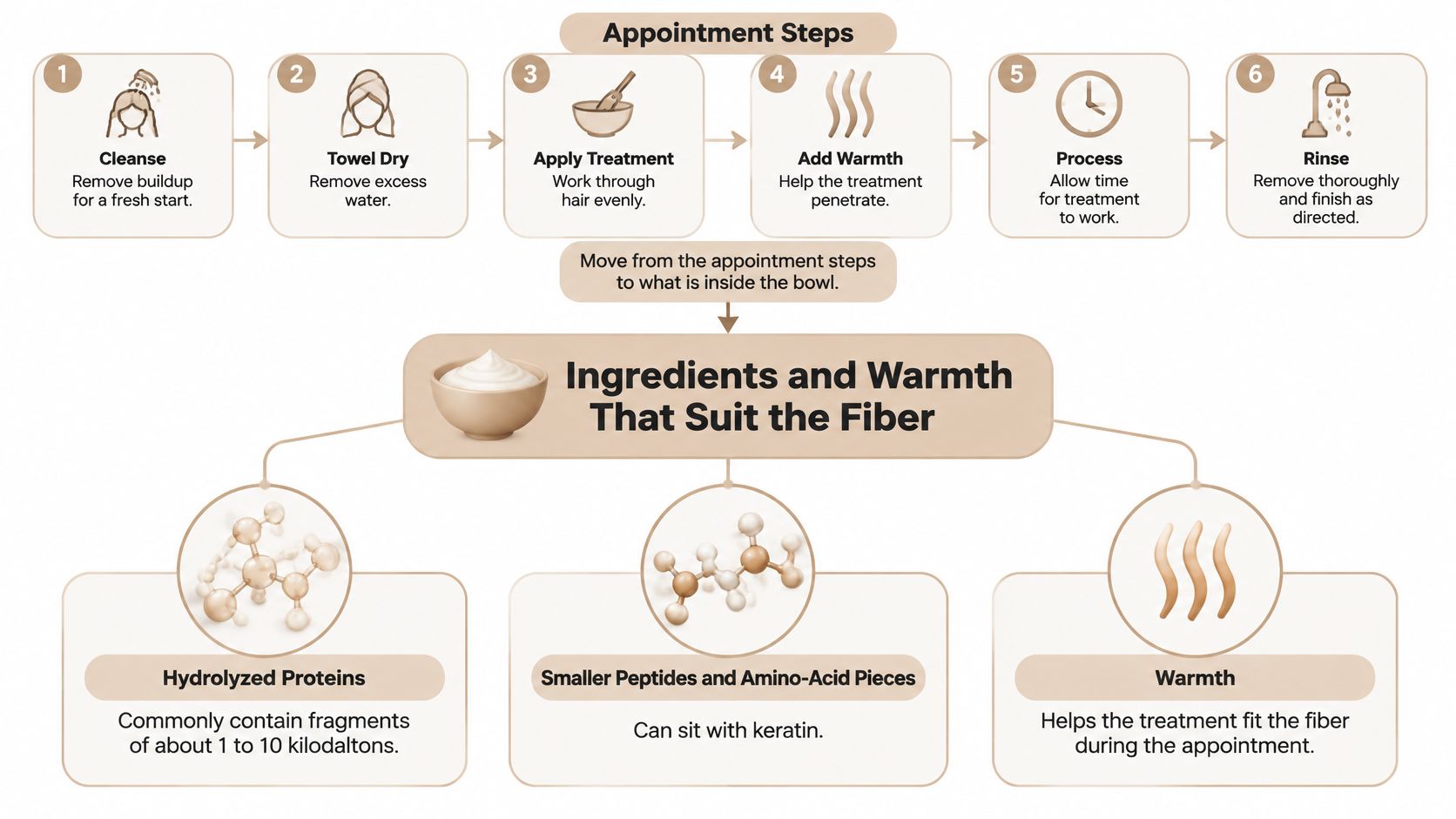
Once you know where product belongs, the next question is what's in the bowl. Ingredient choice in a deep conditioning hair spa comes down to size and surface behavior. Some pieces are small enough to settle into rough spots on the fiber. Others form a film on top. Both can help hair feel smoother, but they don't work the same way.
Proteins sized for damaged spots
Hydrolyzed proteins commonly contain fragments of about 1–10 kDa, according to a clinical review of hair treatment ingredients. Smaller peptides and amino-acid pieces can interact with keratin and temporarily fill or reinforce damaged regions. Larger films mostly stay on the surface, where they still add smoothness and shine.
That word temporarily carries the claim. Protein fragments can patch the feel of a rough area and help hair resist snapping while you comb. They wash away over time, which is why results fade and why regular home conditioning still matters between visits. If your hair feels stiff or straw-like after protein-heavy products at home, say so before the appointment. You may do better with a softer, lipid-focused formula.
Oils and the coconut oil example
Oils and lipid-like ingredients help restore the water-shedding feel that weathered hair has lost. Coconut oil is the concrete example worth naming because its lauric-acid-rich composition and relatively low molecular size give it an affinity for hair proteins and potential access toward the cortex. The same clinical review reports that coconut oil reduced protein loss in both damaged and undamaged hair when used before or after washing, unlike the mineral oil and sunflower oil comparisons discussed there.
That doesn't make coconut oil right for every head. Fine hair can look stringy under oils that coarse, porous hair drinks up. A practitioner should match oil weight to your fiber and concentrate it where dryness lives, usually the oldest hair at the ends.
- Ask what's being applied: protein, oil, or a blend, and in what order
- Ask where it goes: ends only, mid-lengths up, or kept off the scalp entirely
- Mention your history: color, bleach, keratin services, or products that left your hair stiff
Warmth has a ceiling
Gentle, controlled warmth may improve how a treatment spreads by increasing cuticle mobility and fiber swelling. Think of it as helping a thick cream move evenly instead of sitting in patches. Excessive heat pushes the other way. It can worsen dehydration and cuticle damage, so high-temperature drying is a mismatch for chemically processed hair.
A careful spa uses moderate heat only when appropriate, watches how your hair responds, and finishes with low-friction rinsing and blotting instead of rough towel work. The defensible payoffs are manageability, lubricity, shine, and better resistance to breakage while combing. They aren't permanent cortex repair, and they aren't care for scalp disease. Ask what's being applied and where, rather than chasing the richest formula on the shelf. The right match for your fiber beats maximum richness every time.
Three Private Visit Shapes
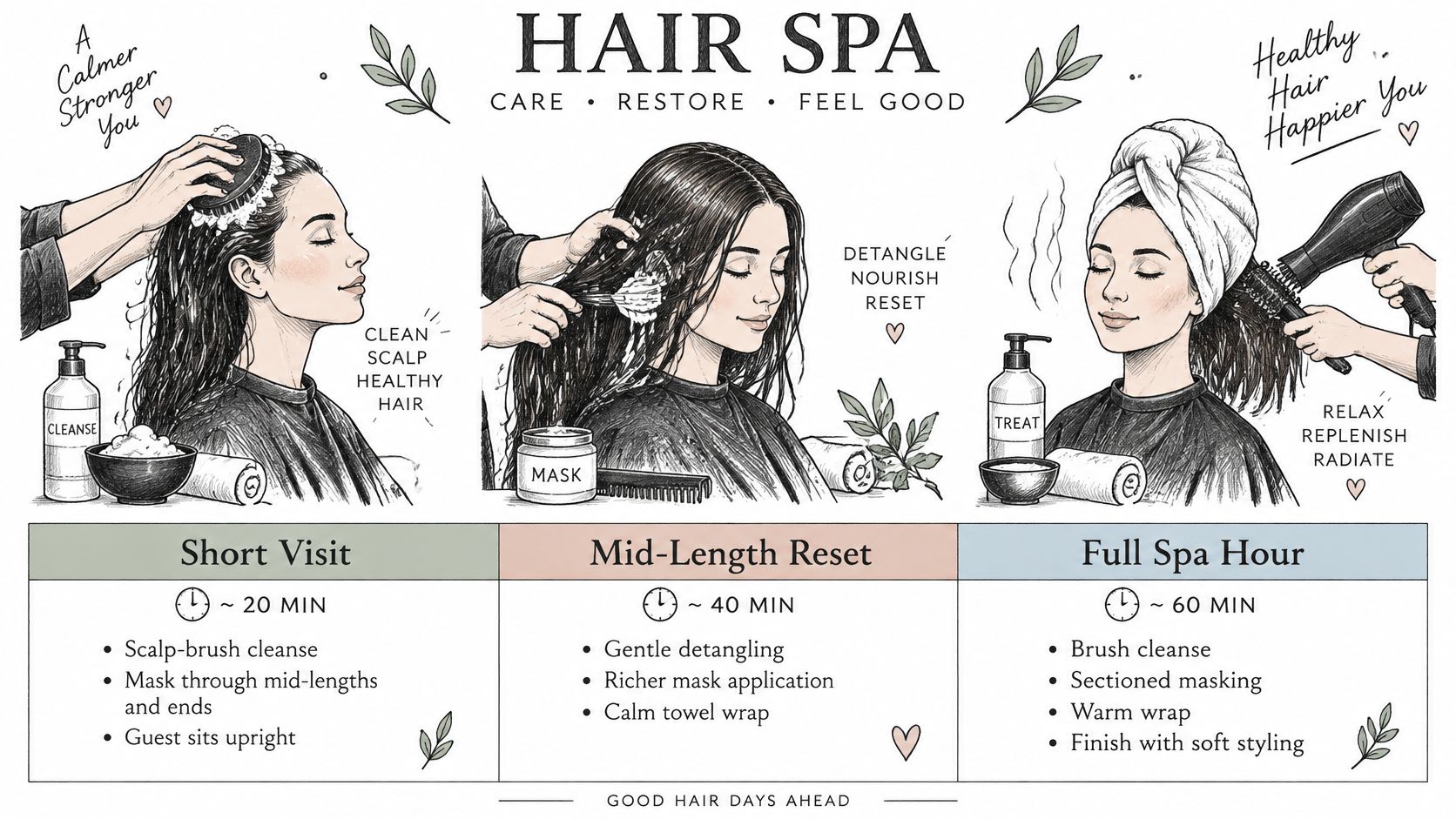
Service menus can blur together, so picture a deep conditioning hair spa as three shapes of visit. The table shows the skeleton first, then each scene fills in how the time feels.
Three private visit shapes
| Visit shape | Steps included | Best fit |
|---|---|---|
| Short | Scalp-brush cleanse, mid-length and end mask, careful rinse, simple dry | Dry ends and limited time |
| Middle | Short-visit steps plus light scalp exfoliation and face, neck, or hand massage | Gentle scalp cleanse and rest |
| Long | Middle-visit steps plus fuller face massage, polished blow-finish, and tea close | Finished look and extended quiet |
Here's how those shapes look side by side before you step into one.
The short and middle visits
The short visit is the focused reset. You recline for a scalp-brush cleanse, the mask goes through your mid-lengths and ends, and you rest while it sits. A careful rinse and simple dry close it out. At Inner You, the Inner Hour ritual uses Oway botanical care for its scalp brush cleanse, and we use natural, plant-based products across treatments. Choose this shape when your ends feel dry and your calendar is tight.
The middle visit adds light scalp exfoliation and massage for your face, neck, or hands while the treatment processes. That detail changes the wait. Instead of lying there aware of every minute, you feel attended to, and the processing time passes as rest. Choose it when you want a gentle cleanse at the roots plus unhurried quiet in the same booking.
This short video shows the kind of slow, hands-on pacing to expect during the treatment portion of a visit.
The long visit and the private room
The long visit layers in a fuller face massage and a polished blow-finish, then closes with quiet tea. Scent, sound, and that closing tea extend the appointment past the rinse. They don't change what conditioner does to your fiber, and they don't need to. They shape how rested you feel when you stand up and whether your hair looks finished for dinner or just clean for the drive home.
We work as a private studio with one guest at a time, so the room, the conversation, and the pace stay personal across all three shapes. You can ask questions, stay silent, or close your eyes without performing relaxation for a roomful of strangers. That privacy is a concrete luxury you can verify the moment you walk in. Pricing and reservation details sit in the closing section, where they belong, so you can choose a shape first and a booking second.
Book a Private Hour Without Overpromising
Book for what you can observe. A trustworthy deep conditioning hair spa describes cleansing, exfoliation, a timed conditioning application, massage, scent, sound, appointment length, and a private room. Those are features you can check with your own eyes and ears. The FTC health products compliance guidance states that advertisers must possess a reasonable basis for objective claims before publishing them, and health-related claims require appropriate substantiation. That standard is why this page describes the visit itself instead of promising medical outcomes.
Three mix-ups to retire before you book
First, a smoother comb-through means your strands carry more lubrication. Hair can feel stronger because the fibers slide past each other instead of grinding, even though nothing inside the cortex has been permanently reconstructed. Second, a relaxed mood after massage tells you the hour was comfortable. Treat that as the benefit it is. You are allowed to book purely because sixty minutes of quiet touch sounds good; you do not need a health claim to justify it.
Third, a video caption has to stay inside what the clip shows. Short videos are useful here because you can see the room, the reclined setup, and the sequence of steps before you commit. Watch for pacing and privacy, the two things a clip can prove.
What the Inner Hour includes
Our Inner Hour Head Spa Ritual is a 1 hour treatment that costs $169 and includes aromatherapy, therapeutic head massage, a scalp brush cleanse with Oway botanical care, waterfall therapy, guided meditation, sound therapy, an express blow-dry, and tea reflection. That is the full observable list. Each item is something you will see, hear, smell, or feel during the hour.
Privacy here is a format you can verify. Standard appointments serve one guest at a time, so the room stays yours for the whole session. On Sundays, Inner You Together pairs two guests: one enjoys the head spa while the other receives a body massage, so you can share the outing without sharing a treatment floor.
Book the private room, the timed steps, and the quiet. Let softer, easier-to-comb hair be the grooming result, not a medical promise.
Location, booking, and the clinician line
We are at 4622 Van Nuys Boulevard, second floor, suite 9, Sherman Oaks, CA 91403, a private studio upstairs from a hair salon on the ground floor. A first visit comes with a $30 gift. Tell us when you book if your hair is color-treated, if protein products leave it stiff, or if you would rather skip added warmth, and we will match placement and product weight to your fiber.
One last decision protects you. Choose a clinician instead of a longer appointment for ongoing shedding, pain, scaling, or inflammation. Those symptoms deserve examination, and no amount of conditioning time substitutes for it. Choose the private hour when your goal sounds like this: dry ends that need slip, a scalp surface that needs a careful cleanse, and a quiet room where one practitioner works on your hair at an unhurried pace. That is a specific, honest reason to book, and it is enough.
If your ends feel rough and you want that care delivered slowly, in a room booked for one guest at a time, reserve the Inner Hour through the Square booking page or by texting (323) 716-3338. You will get a clear sequence of cleansing, timed conditioning, massage, and a tea close in Sherman Oaks, with no medical promises attached.
Written with the Outrank tool