Hair and Scalp Massage: What It Does and Doesn't
Hair and scalp massage explained: how the technique works, what research shows, privacy, comfort and ritual, and when to skip it before your visit.
If a scalp massage feels wonderful, does that mean it's helping your hair grow? Not necessarily, and that distinction makes it easier to choose a session for the right reasons. Hair and scalp massage can be a carefully paced comfort ritual without being a hair-loss treatment, and a thoughtful appointment should make room for both pleasure and honest expectations.
What Hair and Scalp Massage Is and Why People Book It
A client sits down after a long week. As fingers move slowly across her scalp, she notices the pace before anything else: there's no hurried scrubbing, no rush toward the next step, and no need to keep a conversation going.
Hair and scalp massage means hands-on pressure and rhythmic movement applied to the scalp, sometimes extending to the neck and surrounding areas. The practitioner works through the hair to reach the skin rather than pulling or rubbing the strands themselves. Cleansing and a restful setting may accompany the massage, but they aren't what defines it.
A deliberate pause rather than a quick shampoo
A shampoo-style rub is primarily about distributing cleanser and rinsing it away. A full massage session gives the practitioner room to adjust pressure, timing, transitions, and pace around the guest's comfort.
People book for different reasons:
- Space from everyday noise: A visit provides a reason to put the phone away.
- A freshly cared-for feeling: Cleansing and attentive touch can make the appointment feel complete.
- Personal attention: Someone else takes care of the details while the guest rests.
Think of the scalp like the back of a hand held up to a window: familiar, but rarely noticed closely until you pause. If you've been holding yourself stiffly, slow touch can feel like releasing a held breath.
A head spa is the wider ritual around this hands-on work. The massage is its center, while preparation, sensory details, privacy, and a considered ending shape the experience around it.
How Scalp Massage Works Under the Fingers
Common scalp massage techniques and what they feel like
| Technique | How It Is Applied | Typical Sensation |
|---|---|---|
| Effleurage | Long gliding strokes with flat fingertips from hairline to crown | Smooth and settling |
| Petrissage | Lifting and gently squeezing the scalp between fingers | Warm and loosening |
| Circular kneading | Small circles with finger pads, working outward from the crown | Focused and relaxing |
| Tapotement | Light rhythmic taps with fingertips across the scalp | Lively and awakening |
| Scalp brushing | Soft-bristled brush drawn across the scalp after cleansing | Fresh and lightly tingling |
These descriptions are a vocabulary for touch, not a checklist every practitioner must complete. Effleurage introduces broad contact; petrissage adds gentle tissue movement; circular kneading concentrates that movement in smaller areas. Tapping changes the rhythm, while brushing adds a different surface sensation.
Pressure passes through the skin and soft tissue. Gliding and friction can create surface warmth, but warmth isn't a measure of effectiveness, and rubbing harder isn't the aim.
The illustration maps the physical actions involved.
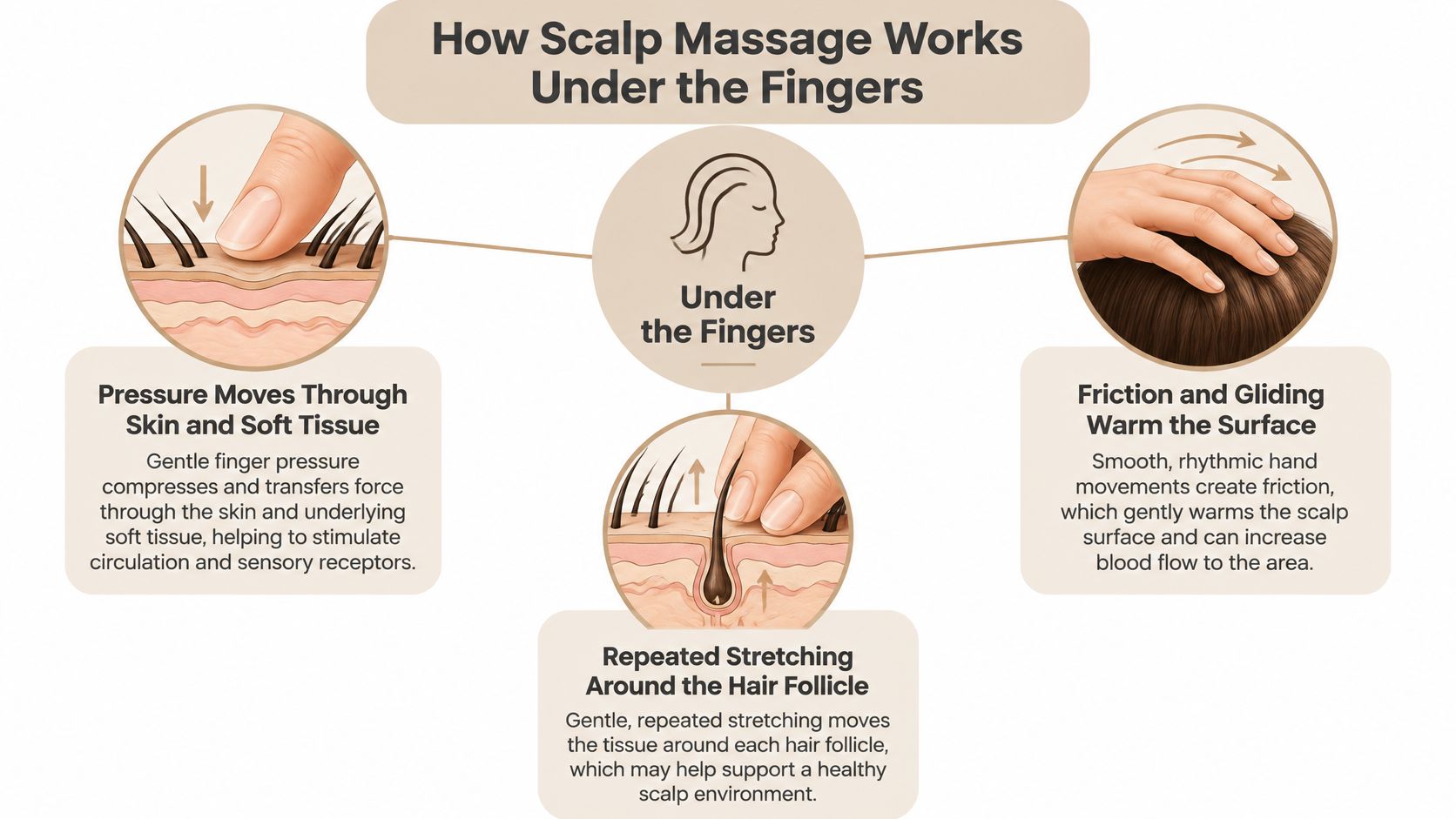
Repeated stretching around follicles is a proposed explanation for possible changes in hair characteristics, not an established pathway to regrowth. The infographic's reference to circulation shouldn't be read as proof that massage produces new hair.
Try the basics gently at home
- Start with clean, dry hair and place your fingertip pads, not your nails, at the hairline.
- Glide slowly toward the crown for about one minute, keeping pressure light.
- Lift and gently squeeze small areas of scalp where the skin moves comfortably. Don't pinch hair or force a grip.
- Finish with small circles around the crown and along the back of the neck.
- Stop immediately if anything stings, feels tender, or looks irritated. If your scalp is sensitive, use the cautions below before repeating.
Slow, continuous movements suit a restful session; lighter tapping creates a livelier rhythm. Neither is naturally better.
Pressure check: You should be able to rest into the touch without bracing your jaw or pulling away.
A good session may feel warm and steady, without sharp fingertip pressure, snagging, or scratching. The finish should become gentler, rather than ending with an abrupt burst of vigorous rubbing.
What Research Shows About Scalp Massage and Hair
Research is early and small, and the available studies don't establish scalp massage as a reliable treatment for hair loss. That distinction matters, because a treatment and a comfort ritual are different promises.
Key scalp massage studies and what they measured
| Study | Participants | Duration | Reported Outcome |
|---|---|---|---|
| 2016 pilot, mechanical massage | 9 healthy Japanese men without baldness | 4 minutes daily for 24 weeks | Average shaft thickness increased from 0.085 mm to 0.092 mm, approximately 8.2%; growth rate didn't significantly change, and the untreated control area showed no significant changes |
| 2019 survey, androgenic alopecia | People self-identifying with pattern hair loss | Median daily effort of 11–20 minutes; average adherence of 7.4 months | 68.9% reported stabilized hair loss or regrowth; self-reported, with no randomized untreated control group |
| 2024 aroma scalp massage study | 16 participants receiving hair-loss management | Not reported | Reported t-statistic of 2.256 for reduced hair loss during shampooing, marked statistically significant; small sample |
The pilot measured hair-shaft thickness, which is the width of an individual strand. That isn't the same as hair density, the number of hairs within an area, or growth rate, how quickly a strand lengthens. Hair measurements work like measurements of a field: the thickness of each stalk, the number of stalks per row, and the speed of growth are three separate questions. A change in one doesn't establish improvement in the others.
The pilot also used a standardized mechanical device. Its findings can't automatically be transferred to a practitioner's hands, a home brush, or a differently paced spa appointment.
How to read the more encouraging results
The survey captures what respondents believed happened while following a massage routine. That's useful for understanding perceived benefit and the effort people maintained, but it doesn't show what would have happened without massage. It also doesn't make the reported percentage a medically verified success rate.
The aroma scalp massage study needs similar restraint. A t-statistic describes a statistical comparison; it isn't a percentage reduction in shedding or a prediction of what an individual guest will experience. Because the study's length isn't reported, it offers no timeline for when any change might appear.
None of these findings demonstrates the creation of new follicles. Stronger randomized trials are needed to separate a massage effect from other influences and establish whether particular methods produce meaningful outcomes.
For a spa guest, the sensible position is straightforward: treat scalp massage as a comfort ritual with possible hair-shaft effects, not a proven hair-loss treatment.
How a Head Spa Ritual Builds Around the Massage
A head spa visit has a beginning, a central period of hands-on care, and an unhurried return to the day. Studios such as Inner You in Sherman Oaks build around that progression, rather than treating the massage as a quick extra during washing.
The sequence below shows the broad shape of a visit.
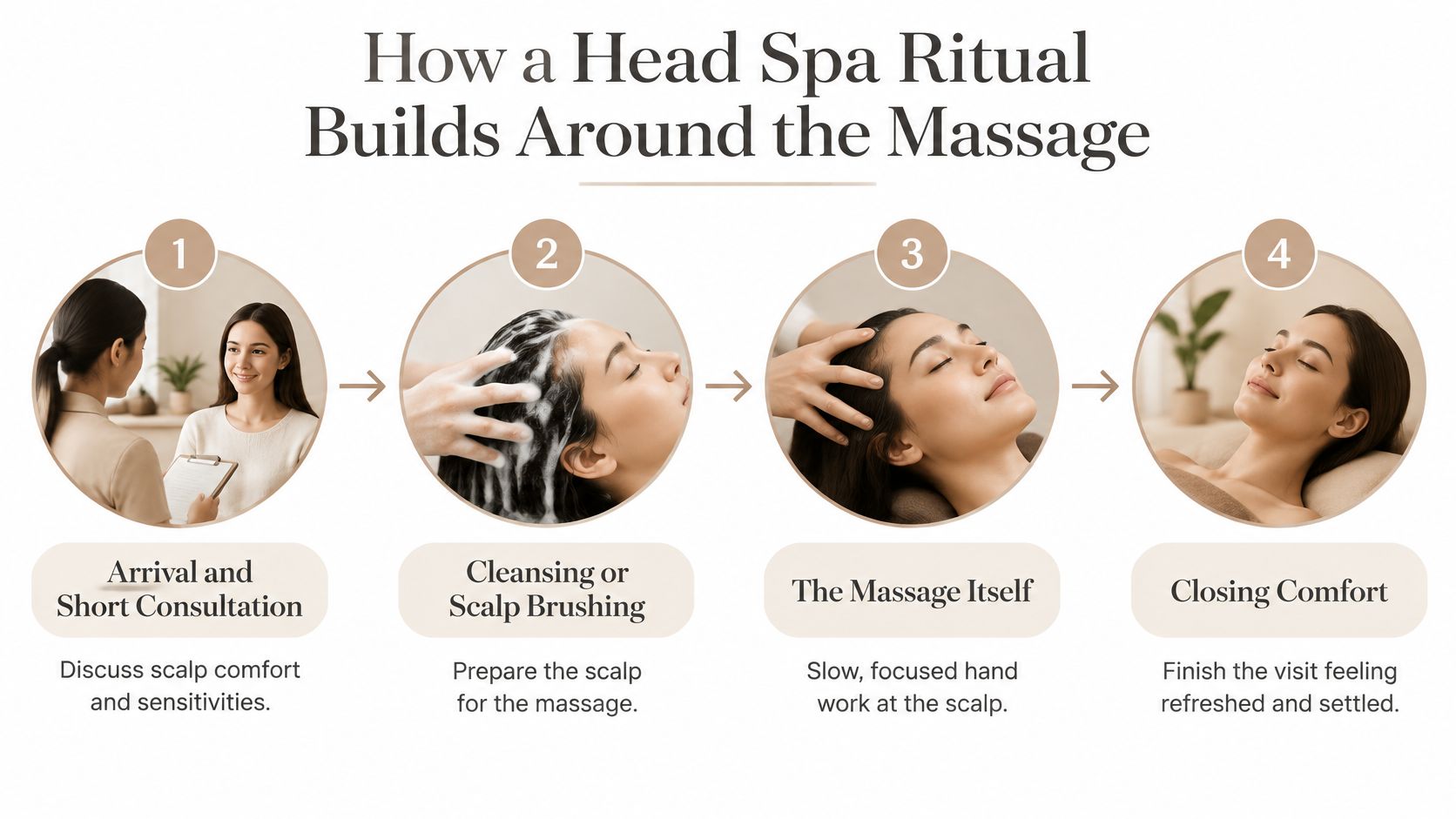
Arrival and preparation
The visit begins with a conversation about how your scalp feels and anything you'd like the practitioner to avoid. Mention fragrance sensitivities, uncomfortable areas, and whether you prefer silence or occasional explanations.
Cleansing or gentle scalp brushing then prepares the area for touch. This should feel like preparation, not an attempt to scrub away every visible flake.
Once the hands-on work begins, the practitioner can adjust the rhythm and contact to your preferences. You don't need to endure a technique because it appears on a treatment description.
Scent, sound, and a considered ending
Aromatherapy can enter a ritual in distinct ways. A 2025 review of aromatherapy describes inhaled scent, essential oils applied during massage, and aromatic substances placed in the environment as separate approaches, while noting the importance of standardized methods for reliable comparisons.
In a comfort-focused appointment, scent contributes atmosphere. Essential oils aren't presented as treatment for anxiety, pain, scalp disease, or another medical condition, and a pleasant fragrance shouldn't take priority over your tolerance.
Gentle tones, vibrations, and guided meditation may accompany the quieter part of a visit. An invitation to breathe slowly should remain an invitation, not another task to perform correctly.
You're allowed to prefer less scent, softer sound, or no conversation. Comfort isn't a test of how much stimulation you can tolerate.
A closing tea ritual creates a clear transition before you collect your belongings and leave. The order matters because it avoids moving straight from concentrated touch into a hurried departure.
Hair care can have its own purpose within that sequence. If you're comparing scalp-focused touch with conditioning the lengths, our guide to a deep-conditioning hair spa explains that separate part of the experience.
Why Private Setting and Comfort Change the Experience
The same touch can feel different when you're listening to nearby conversations, watching people pass, or wondering whether someone else can see you. A private appointment removes those particular distractions without needing to promise a health outcome.
This comparison illustrates the difference in atmosphere.
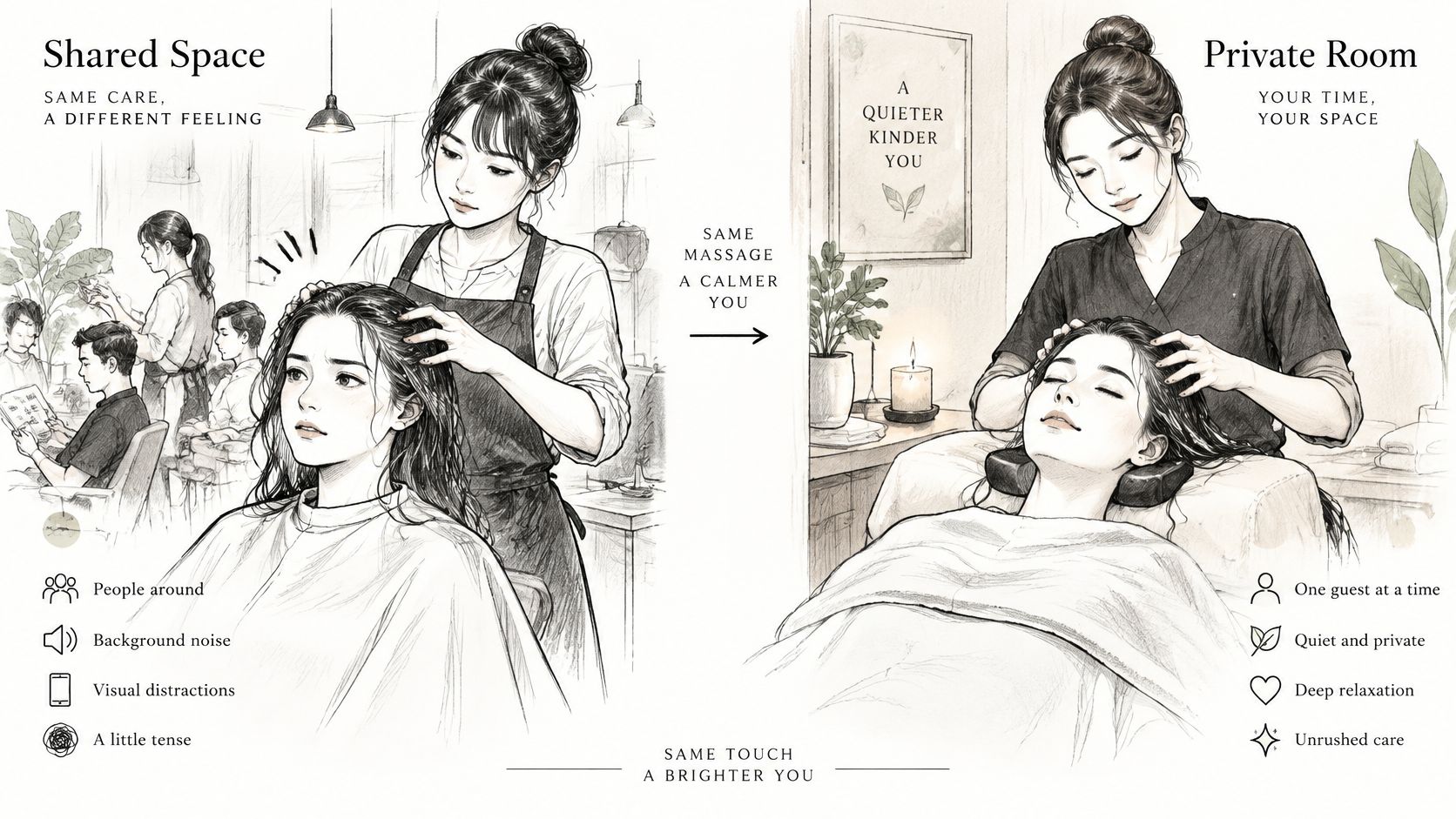
At Inner You, standard appointments serve one guest at a time. Compared with a shared treatment environment, that offers more personal space and discretion, including the freedom not to make small talk or explain why you wanted time away.
Privacy without exaggerated promises
California Government Code section 51034 recognizes a client's reasonable expectation of privacy in massage establishments by limiting certain local requirements that would interfere with it. This applies to local regulation in places including Los Angeles; it doesn't require a particular room design or establish a medical benefit.
When comparing settings, consider practical details:
- Visual privacy: Can you settle in without feeling on display?
- Lighting and sound: Are the brightness and volume comfortable for you?
- Temperature and scent: Is there a clear way to request an adjustment?
- Personal space: Does the appointment feel focused on your visit rather than surrounding activity?
Video can also help you judge the atmosphere before arriving.
Luxury doesn't have to mean more products or elaborate decoration. It can mean not having to monitor the room, fill a silence, or compete with nearby noise. Privacy gives the other sensory details room to be enjoyed on your terms.
Limits, Cautions and Common Misconceptions
Gentle scalp massage may suit a healthy scalp, but gentle doesn't mean appropriate for every scalp. Use visible symptoms and discomfort as reasons to pause, not as problems a stronger massage should overcome.
Scalp conditions and whether massage is appropriate
| Condition or Sign | Massage Suitable? | What to Do First |
|---|---|---|
| Healthy scalp, seeking relaxation | Yes, with gentle pressure | Book as usual and mention any sensitivities |
| Active eczema, psoriasis or seborrheic dermatitis | Postpone | Get dermatology advice before booking |
| Redness, scaling, tenderness or broken skin | Avoid until assessed | Pause and seek a professional check |
| Suspected fungal scalp infection | Avoid until treated | Get medical evaluation first |
| Sudden or patchy hair shedding | Not a substitute for diagnosis | See a dermatologist |
| Fragrance or essential-oil sensitivity | Only with a tolerated, unscented option | Disclose at booking and discuss suitable products |
Friction can be uncomfortable on already irritated skin, and trying to brush away adherent scale can turn a soothing appointment into scratching. The Mayo Clinic's seborrheic dermatitis guidance advises against scratching or picking because these actions can increase infection risk.
A short pre-treatment scalp check helps identify reasons to stop or modify the planned service. It isn't a diagnosis, and a practitioner shouldn't label unexplained redness or shedding as simple buildup.
Three assumptions to leave behind
Massage isn't established as a way to regrow hair on its own. If you notice sudden shedding, a new patch, or a changing hairline that concerns you, arrange an assessment rather than buying a series of appointments on a regrowth promise. A spa visit shouldn't delay that conversation.
Deeper pressure isn't better. There's no reason to press through pain, scrape with a brush, or use fingernails to make a session feel more effective. After a diagnosed scalp condition, follow the clinician's advice about when touch can resume and which areas or products to avoid.
Aromatherapy isn't a treatment for stress or skin conditions. Natural and plant-based don't automatically mean suitable for sensitive skin. Tell the practitioner what has irritated you before, including fragrance applied to the room rather than directly to your scalp.
Before you book: If your scalp hurts, has broken skin, or is changing unexpectedly, choose assessment before massage.
The boundary is simple: a spa practitioner provides comfort-focused care. They don't diagnose dermatitis, treat infection, or determine the cause of unexplained hair loss.
Choose Your Session and Book a Visit
Book for the hour you can keep. A good choice matches three things: the time available, the privacy you want, and what your scalp can tolerate that day. Comfort is the part you can evaluate before you arrive; any hope for hair change should stay separate from the booking decision.
A defined starting point
The Inner Hour Head Spa Ritual is a one-hour treatment priced at $169. It includes aromatherapy, therapeutic head massage, a scalp brush cleanse with Oway botanical care, waterfall therapy, guided meditation, sound therapy, an express blow-dry, and tea reflection.
Here, therapeutic head massage is the service description, not a promise to treat a medical condition. The appointment brings hair care and sensory comfort together within a set period, like a well-planned pause with a clear beginning and end.
A first visit comes with a $30 gift. We're a private spa studio at 4622 Van Nuys Blvd, 2nd floor, suite 9, Sherman Oaks, CA 91403.
Prepare for the visit you actually want
Before booking, make a few notes you can hand over without trying to recall details once you're settled:
- Scalp history: Include recent irritation, diagnosed conditions, and anything currently active.
- Product sensitivities: Name fragrances, essential oils, or hair products you already know you don't tolerate.
- Touch preferences: Mention areas to avoid and whether you prefer lighter contact around the hairline, neck, or temples.
- Time available: Choose a session length that leaves room to arrive, change, and leave without rushing.
Use that short list to shape the appointment around comfort and pacing. Choose your session length, note your scalp needs, and book a private appointment with those preferences in mind.
At Inner You, we offer private head spa appointments that combine attentive scalp care with a considered sensory ritual. Visit Inner You to choose your session and reserve time for hair and scalp massage centered on your comfort, privacy, and preferences.
Powered by Outrank app