Head Spa Benefits: Realistic Scalp Care and Relaxation
Explore head spa benefits for relaxation, scalp cleansing and privacy, with realistic expectations on what one private session can and cannot do.
The question worth asking before you book a head spa is not "does it work," but "what part of it works, and how much?" Search for head spa benefits and you'll meet two stories that don't match. One promises thicker hair and a detoxified scalp. The other is what you walk out with: a clean, comfortable scalp and a quieter nervous system for the rest of the day.
Neither story is a lie, but only one of them holds up. A head spa appointment as a package hasn't been tested in clinical trials, the massages that have been studied happened at home with a handheld device, and the relaxation research is about touch in general rather than one studio's protocol. That doesn't make the appointment less worthwhile. It makes it easier to describe clearly.
What follows separates the parts of head spa benefits you can count on from the parts that outrun the evidence, explains what each step of a session is doing, and flags the situations where a spa visit is the wrong answer.
What Head Spa Benefits Are Realistic to Expect
Six benefit areas come up again and again, and they don't all rest on the same foundation. The table below is the version you can take into a booking conversation without overpromising.
| Benefit area | What the session provides | Evidence strength | How to describe it |
|---|---|---|---|
| Relaxation and physical tension | Scalp and body massage, guided breathing, quiet time | Moderate; short-term effects from touch research | Temporary relaxation and perceived comfort |
| Feeling of stress | Aromatherapy, guided meditation, sound therapy | Moderate for short-term anxiety measures | A calm hour to pause and unwind |
| Scalp cleansing | Scalp brush cleansing, exfoliation, rinse | Cosmetic; based on the known role of cleansing in removing buildup | A cleaner, lighter-feeling scalp |
| Hair appearance | Hair treatment and professional blow-dry | Limited; one small study on hair thickness | Hair that looks and feels well cared for, not regrowth |
| Facial comfort | Facial massage with lymphatic-style techniques | Limited; mainly supports comfort and the look of temporary puffiness | A relaxed, refreshed-looking face for the day |
| Privacy and luxury | One guest at a time, personal attention, tea ritual | Experiential, not clinical | A private, personal retreat |
Read the rows in two groups. The first two are felt benefits: short-term shifts in how tense and how wound-up you feel. They're real, they're measurable in studies of touch and massage, and they're temporary. The middle three are cosmetic and maintenance benefits: cleansing, conditioning, and a face that looks less puffy for a while.
The last row isn't evidence at all, and that's fine. Privacy and unhurried attention are service design, not treatment.
A head spa is an acute experience. One appointment, one afternoon. Whatever it does for your shoulders or your mood, it does on the day and lets go over the following days. That's the honest frame, and it's the same frame a good massage therapist uses.
The line to hold: a head spa offers comfort and cosmetic scalp care. It does not diagnose, treat, or cure anything.
So how do you know a session worked? Three checks, and none of them require a before-and-after photo.
- You leave calmer than you arrived. Slower breathing, looser jaw, less urgency in how you move.
- Your scalp feels clean and lighter. Not tight, not stripped, not itchy.
- Your hair looks cared for. Smooth, easier to manage, styled the way you'd style it on a good day.
Those three outcomes are achievable, honest, and worth paying for. Everything past them needs a different kind of provider.
How a Head Spa Session Unfolds Step by Step
No two studios run an identical sequence, but a head spa tends to follow the same arc, and knowing the reason behind each step makes the appointment easier to relax into. A common worry before a first visit is not knowing what happens next or when to speak, so it helps to see the shape of the hour in advance. The process condenses into four stages: a conversation, settling in, the treatment itself, and a slow close.
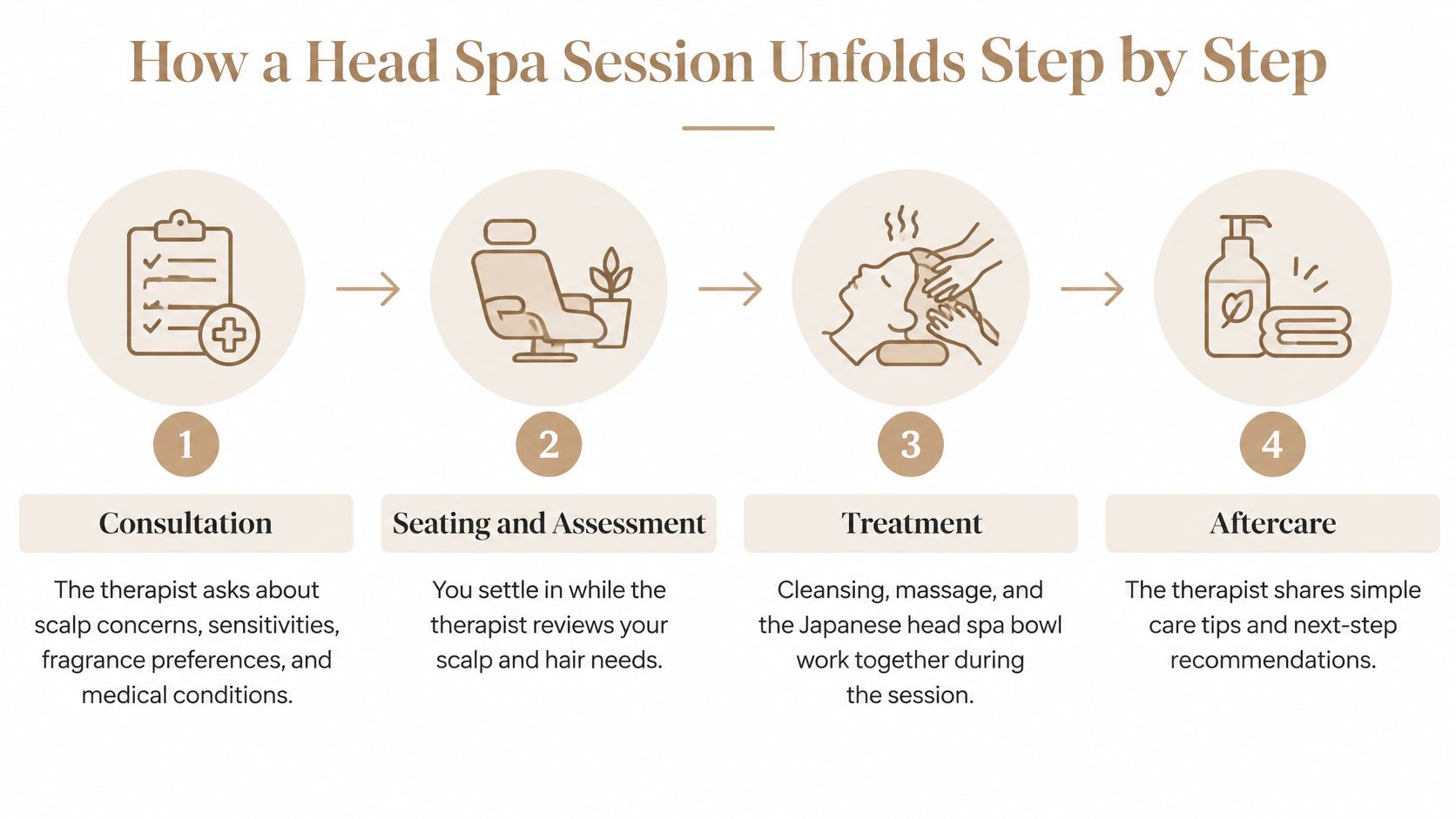
Consultation. Your therapist asks about scalp concerns, sensitivities, fragrance preferences, and any medical conditions before you sit down. The reason is simple: pressure, products, and scent all get adjusted now or not at all.
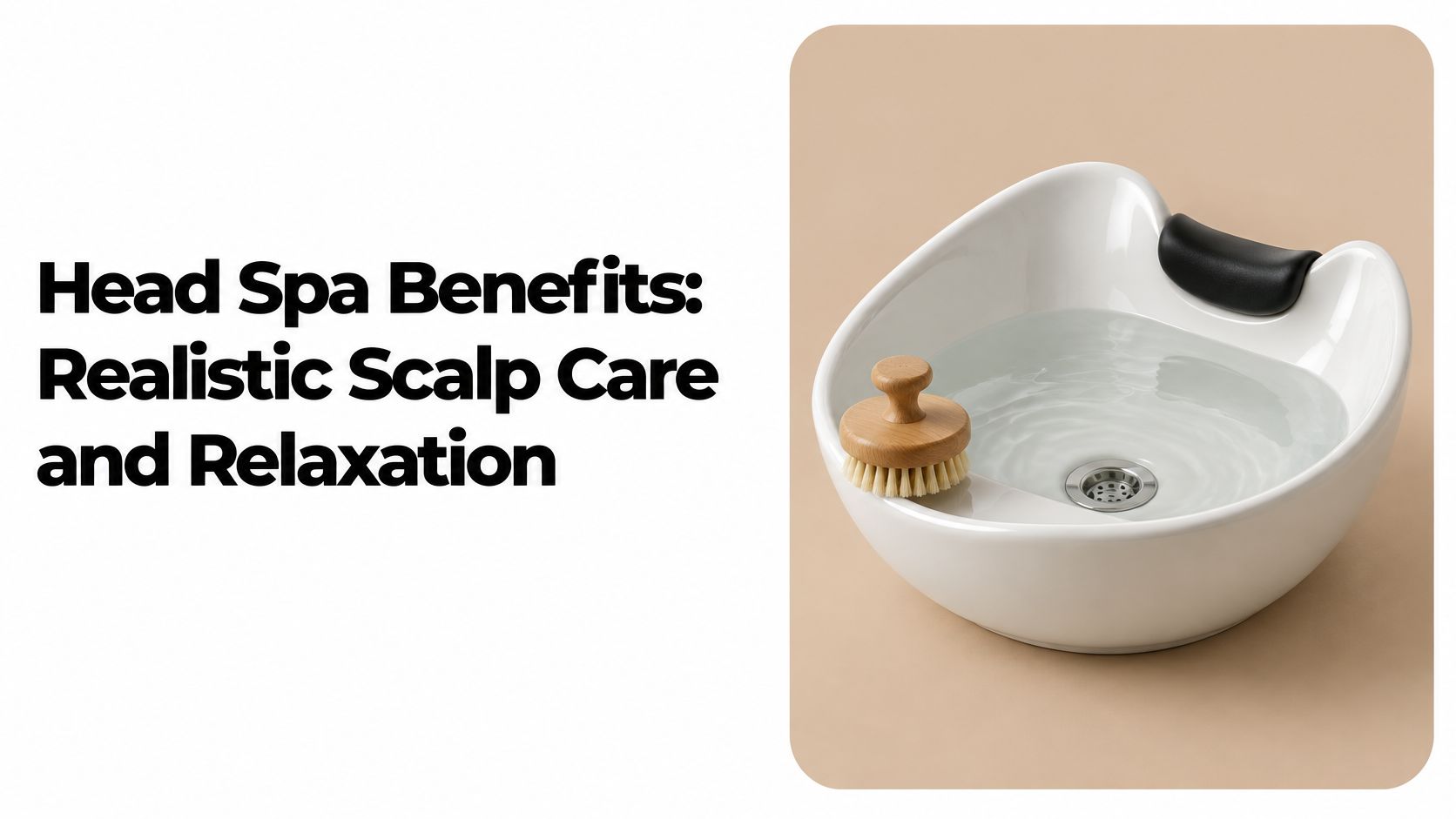
Seating and setup. You settle into a reclined position with your neck and head fully supported. That support matters more than it sounds, because you are not holding your own head up for the next hour, and the drop in effort is where relaxation usually starts.
Scalp cleansing. A brush cleanse with plant-based products lifts surface oil and styling residue. Massage works better on a scalp that isn't coated, and residue is what makes hair feel heavy afterward. If you want to understand how much of a wash is technique and how much is product, our guide to hair washing at a spa breaks down the order of operations.
Massage. Head massage follows at moderate pressure, the kind you'd describe as comfortable rather than impressive. Deep pressure has a paradox: push hard enough and the body braces against it, and a braced neck does not relax. Guided meditation or breathing cues are often layered in here so your attention has somewhere to rest.
Aromatherapy and sound. Each session includes custom aromatherapy made with pure essential oils, along with sound healing built from gentle vibrations and harmonic tones. Think of them as the room's lighting rather than decorations: they set the conditions your senses rest inside. Their job is to give your attention one thing to follow instead of a to-do list.
Rinse and finish. A gentle rinse clears the product, followed by a blow-dry where the appointment includes one. Warm water and a slow rinse belong to the wind-down, so the session ends at the same unhurried pace it began.
Tea reflection. Every session closes with a quiet tea ritual. It exists so you notice how you feel before you rejoin traffic, rather than discovering it in the car.
You can ask for a pause, a lighter touch, or an early finish at any stage. Say it out loud the moment it occurs to you, and a therapist would rather adjust than have you endure something. In a one-guest setting that request is also easy to make, since there is no one else in the room to overhear it.
Relaxation Benefits and What the Research Shows
The steadiest evidence behind a head spa isn't about hair. It's about touch, and the strongest summary of it is a large one.
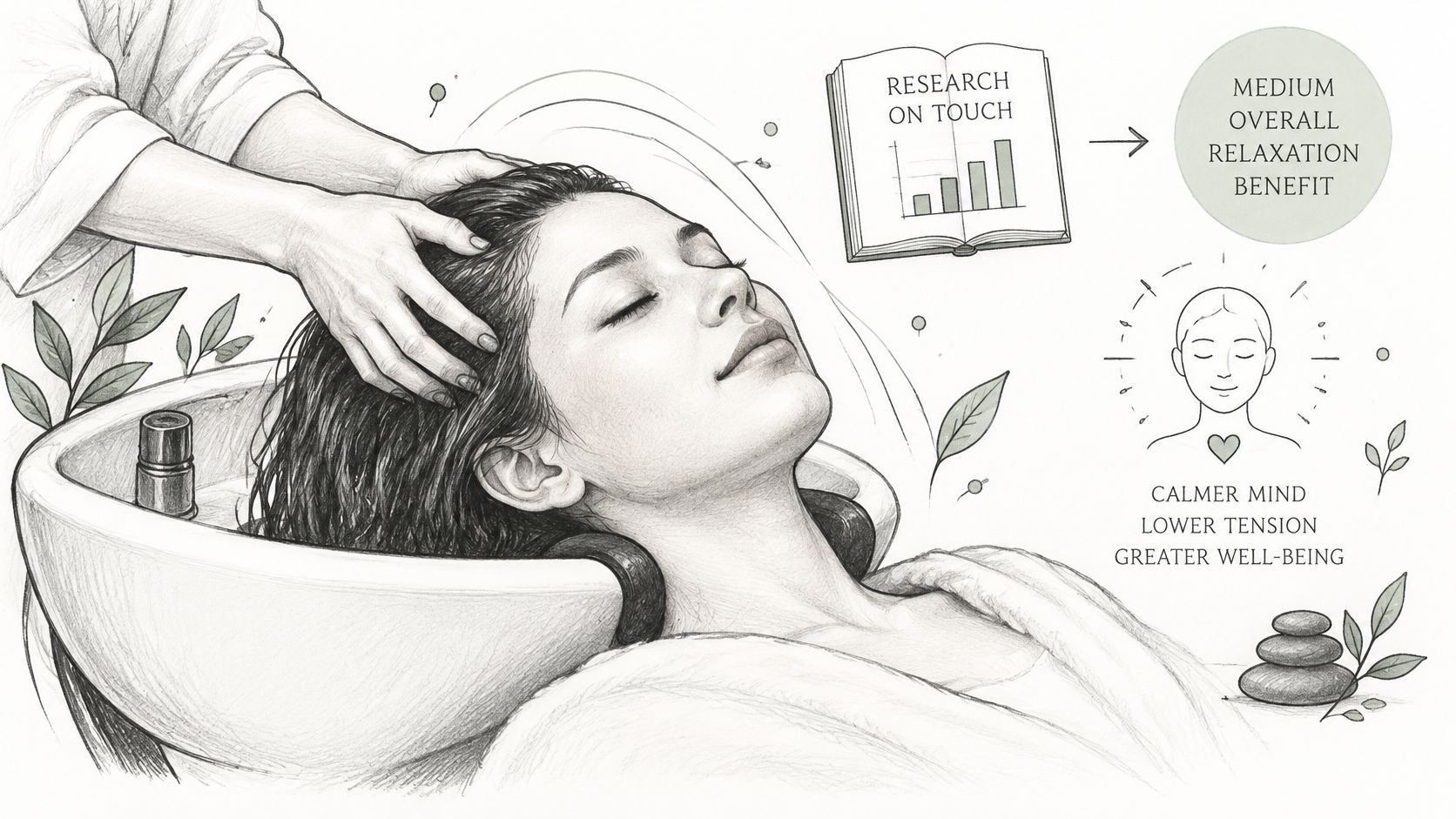
A 2024 systematic review and multivariate meta-analysis published in Nature Human Behaviour pooled studies of touch interventions and found a medium-sized overall benefit. The effects were strongest for pain, state anxiety, depression, and trait anxiety, and weaker for respiratory, sleep, and heart-rate outcomes. The same analysis found touch produced a significantly larger benefit for cortisol-related outcomes than for heart-rate parameters, with a Hedges' g difference of 0.26 and a 95% confidence interval of 0.04 to 0.48, statistically significant at P = 0.024.
Translated: the psychological effects show up more reliably than the physiological ones. Feeling less anxious after an hour of skilled touch is the well-supported part. Assuming your heart rate and stress hormones will move in a predictable way is not.
What This Means for One Appointment
That's the case for describing a session as a short-term way to ease anxious feelings and physical tension, rather than a treatment plan for anxiety. The combination of scalp massage with guided meditation, aromatherapy, or sound isn't decoration either. Layering sensory input is how a relaxation appointment holds your attention, and attention is what stops the mind from rehearsing tomorrow.
The limit is scope. The review covers touch interventions broadly, not one studio's protocol, and it isn't proof that every head spa produces the same effect. Results vary by technique, pressure, setting, and by you.
The effect is real and it is short. A session is a pause, not a cure.
Frequency deserves the same honesty. A single treatment in several studies reduced salivary cortisol and heart rate, but sustained reductions after repeated treatment were not established, according to a review of scalp massage and stress measures. The 2024 review doesn't tell anyone how often sessions must be repeated for lasting change, so judge your own pattern by how you feel between visits rather than by a promised result.
Here's the pace of it in motion, if you'd rather see the handling before you book.
A practical rule: notice how you feel for the rest of the day, and let that be the measure. If you're chasing relief from chronic anxiety, hypertension, or a diagnosed condition, that's a conversation for a clinician, and a spa appointment is a pleasant complement rather than the plan.
Scalp Care and Hair Benefits Stated Accurately
The claim that sells head spas is that massage grows hair. The most-cited study on the subject doesn't quite say that, and once you read the details, the gap between the marketing and the paper is obvious.
A 2016 peer-reviewed scalp-massage study in Eplasty put nine healthy men on a standardized scalp-massage device for 4 minutes daily over 24 weeks, measuring hair number, thickness, and growth rate. Mean hair thickness in the massaged area rose from 0.085 ± 0.003 millimeters to 0.092 ± 0.001 millimeters, roughly an 8.2% gain. That's the headline number floating around the internet.
What the Same Study Also Found
At 12 weeks, hair count in the massaged area fell, from 163.889 ± 7.237 to 155.500 ± 5.607 hairs per square centimeter, a statistically significant decrease. Thickness went up. Quantity did not.
Here's where readers trip: thickness and density are different measurements. Thickness is the diameter of each individual strand, while count is how many strands occupy a square centimeter. The study moved the first number and not the second, so "thicker hair" in this context means slightly plumper strands, not new growth. Nine men is also not a population, and the protocol was a daily device routine at home for almost six months, which is nothing like an occasional salon appointment.
Three separate ideas get bundled into the marketing, and untangling them clears up most of the confusion.
Cleansing is real and cosmetic. Clarifying formulas are designed to strip excess oil, styling residue, dry shampoo, hard-water minerals, and buildup that a regular wash leaves behind, as CNN Underscored's guide to clarifying shampoos explains. Some cleansing shampoos have also been shown in controlled testing to reduce scalp oil after washing. That's a cleansing result, not a hair-growth result.
Massage makes the scalp comfortable. Reduced tension, less sensitivity, the specific relief of a head that's been handled well. It's why people rebook.
Hair loss is a medical question. Sudden shedding, patchy smooth loss, a scalp that stings or burns, scaling, or inflammation all point to a dermatologist, not a repeat visit. Early assessment matters with several scalp conditions where follicles can be permanently affected.
Say it this way: my scalp feels cleaner and my hair looks cared for.
That sentence is accurate, defensible, and it's the one worth repeating to friends. If you want to understand what a proper scalp treatment involves and where it stops, this breakdown of natural scalp treatment walks through the cleansing side in more detail.
A private one-guest studio has a quiet advantage here: with no queue and no audience, a therapist can look closely at your scalp, point out buildup or dryness, and say plainly what the session can and cannot change. If you want the closest match to the 2016 protocol, a handheld scalp massager used daily at home comes nearer than any appointment. Neither habit replaces a dermatologist's assessment when something looks wrong.
Who Should Adjust or Skip Aromatherapy and Scalp Treatments
Scent is the part of a head spa most likely to be described as universally calming, and the part that most needs a real conversation. Essential oils are concentrated plant chemistry, and they can irritate skin, trigger allergic contact dermatitis, and cause photosensitivity.
Cleveland Clinic's aromatherapy overview advises diluting oils before skin application and notes that aromatherapy may be unsuitable for some people with epilepsy, asthma, or skin conditions. A clinical review of aromatherapy cited by the same source reports dermatitis, phototoxic reactions, chemical burns, and toxicity depending on the oil and the route of exposure.
| Situation | Action before booking | Reason |
|---|---|---|
| Pregnancy | Check with your doctor first and ask for a fragrance-free option | Aromatherapy oils are not advised without medical guidance |
| Migraines or frequent headaches | Mention triggers and choose a lighter pressure and a scent-free session | Scents and pressure can trigger symptoms for some people |
| Asthma | Tell the therapist and request no scent | Inhaled essential oils may affect breathing for some people |
| Epilepsy | Consult your doctor before using aromatherapy | Some oils are not suitable for people with epilepsy |
| Eczema or active scalp disease | Seek medical guidance before booking | Irritation and broken skin raise the risk of reactions |
| Fragrance or essential oil sensitivity | Request a fragrance-free treatment and a patch test | Allergic contact dermatitis is a documented risk |
| Recent scalp surgery or broken skin | Postpone the session until healed | Undiluted or direct contact can cause irritation or chemical burns |
| Uncontrolled cardiovascular condition | Get medical clearance before a head massage | Pressure and relaxation changes should be supervised |
Four principles sit behind that table. Consent first: nothing should be applied to your scalp that you haven't agreed to, which means full disclosure of every oil and product before the session starts. A fragrance-free option on request, offered without a debate about why you want it. No undiluted oils and nothing applied to broken or inflamed skin, because damaged skin absorbs differently and reacts faster.
And a patch test when you know you're reactive, either beforehand or on a small area at the start.
Inhalation and topical exposure carry different risks, which is why "it's only a scent" isn't a defense. Inhaled oils reach the airways and the brain quickly; oils on skin sit in contact with a large, well-supplied surface for the length of your appointment.
Tell your therapist about scalp tenderness, migraine triggers, dizziness, or nausea before you're in the chair, not after.
You can stop at any point, and a good therapist will check in rather than assume silence means comfort. If you have active scalp disease or significant allergies, get medical guidance before booking. Our notes on choosing an aromatherapy spa near me cover how to ask about oils by name. Around here, scent is a layer you can decline entirely, and the session still works.
Why a Private Setting Changes the Experience
A shared treatment room runs on other people's schedules. The blow-dryer two chairs over, the phone ringing at reception, a conversation happening above your head while you're meant to be switching off. In a one-guest studio, none of that exists for the hour you're there.
The difference shows up in research as well as in atmosphere. Privacy is a documented weak point in shared treatment environments: a 2025 mixed-methods study of 821 emergency-department patients found that 24% reported unsatisfactory privacy experiences, and those patients had no say over where they were placed. Private rooms sidestep that problem by design. When only one person is being treated, there is no neighbor to overhear and none to be overheard by.
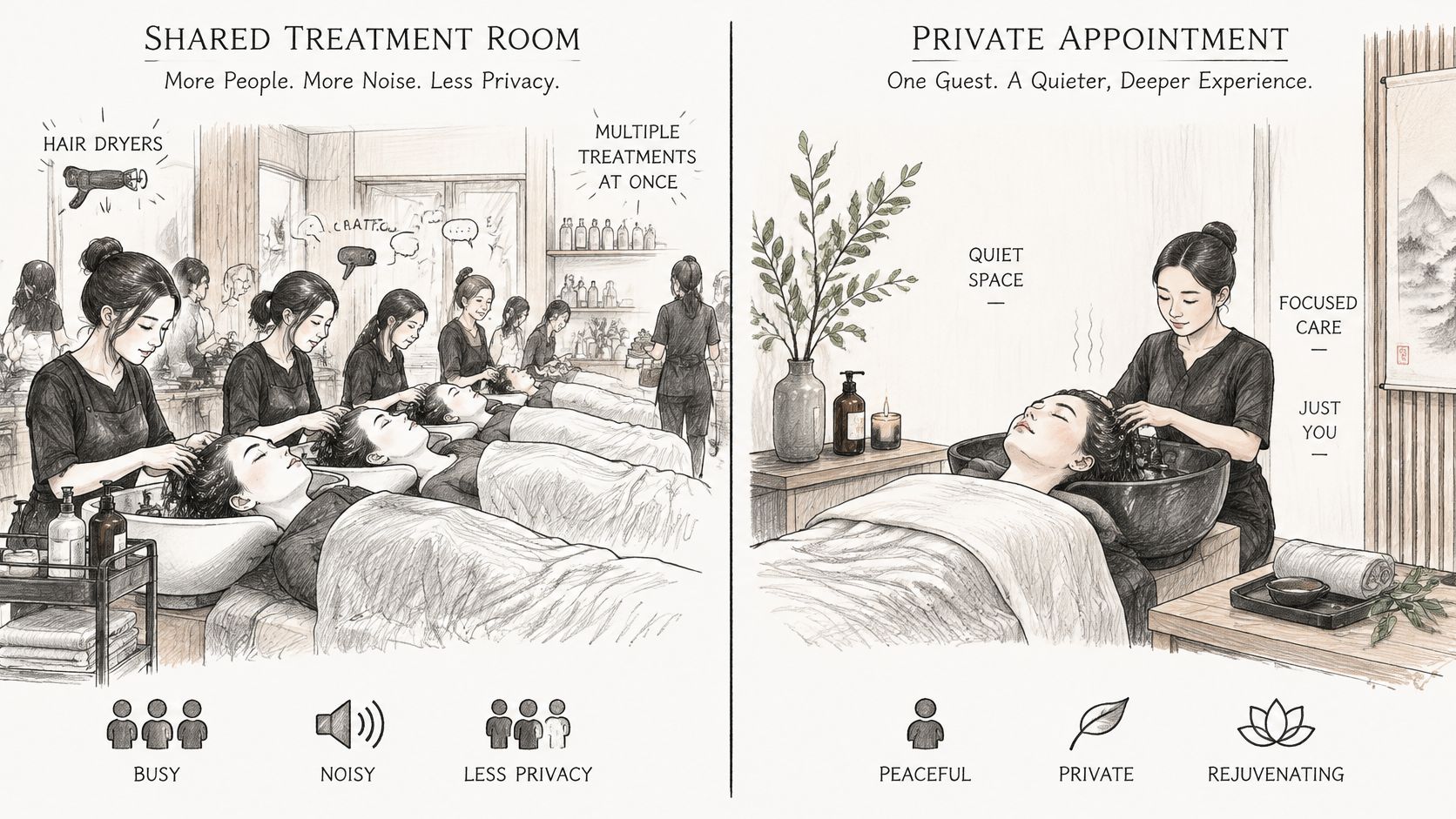
A head spa magnifies the usual awkwardness of being observed. You are lying back with wet hair and no makeup, eyes closed, while someone works slowly across your scalp. In a shared room you might lower your voice to ask for a lighter touch, or hold back a question rather than explain it within earshot of strangers. It works like the difference between a communal changing room and a private one: the activity is identical, but your willingness to relax inside it is not.
In a one-guest setting, that relaxation comes more easily because the session has nothing to compete with:
- Your own time, with no overlap from the guest before or after.
- Your own pace, so the massage can run long and the rinse can slow down.
- A private conversation, including the screening details you'd rather not announce across a room.
- A quiet tea ritual at the end, where the appointment settles instead of stopping.
One honest caveat: privacy sits on the comfort side of the ledger. It won't change what a head massage can do for your scalp, but it changes how fully you can settle into the hour, because the session bends to you when there's no one else to bend around. Discretion, comfort, and undivided attention are the product here, and that's a reasonable thing to pay for.
Book Your Private Session with Clear Expectations
Booking well takes three small checks, and none of them takes more than a few minutes.
Run through the screening list. If any row applies to you, especially pregnancy, migraine triggers, uncontrolled cardiovascular issues, or an active scalp condition, get guidance first and mention it when you reserve.
Flag your scent preferences. Every session includes aromatherapy blended from pure essential oils, so if fragrance is a migraine trigger or a sensitivity, say so at booking rather than once the oils are already in the air.
Set a realistic goal for the day. Aim for a calmer afternoon, a scalp that feels clean, and hair that looks cared for. Regrowth and medical fixes sit outside what any spa session can promise, and expecting them only guarantees disappointment.
If you're deciding between rituals, start with the Inner Hour head spa ritual, a one-hour treatment at $169 that includes aromatherapy, therapeutic head massage, a scalp brush cleanse with Oway botanical care, waterfall therapy, guided meditation, sound therapy, an express blow-dry, and tea reflection. Renewal adds scalp exfoliation, a hair treatment, and facial care at $229, and Voyage adds a face massage and professional blowout at $299. Your first visit comes with a $30 gift.
Inner You is a private spa studio at 4622 Van Nuys Blvd, 2nd floor, suite 9, Sherman Oaks, CA 91403. Reservations run through Square or by text message, and each appointment serves one guest at a time, so the hour is yours alone. Share any health condition, sensitivity, or concern when you book. That one sentence keeps the appointment comfortable and keeps the claims honest.
Inner You is a private head spa studio in Sherman Oaks, built around a single guest at a time, the warmth of waterfall therapy, and a session that ends with tea rather than a checkout counter. If the head spa benefits you're looking for are a cleaner-feeling scalp, an unhurried hour, and a calmer afternoon, that's exactly what the Inner Hour was designed to deliver. Visit Inner You to see the rituals and reserve your appointment.