Head Massage for Migraine: What the Evidence Supports
Learn what research shows about head massage for migraine, when to skip it, and how to book a gentle, relaxing session safely.
In a study of 64 people with migraine, repeated massage sessions were associated with fewer attacks than waiting for treatment, according to the National Center for Complementary and Integrative Health. That's an encouraging finding, but it isn't evidence that a scalp massage can stop an attack already underway.
The useful question about head massage for migraine is therefore not whether it works. It's whether gentle touch fits your situation today, what you want from the appointment, and how to keep a relaxation practice separate from medical treatment. For a private head spa, the appropriate promise is comfort, personal attention, and an adjustable sensory experience, not migraine prevention or relief.
What the Studies Say About Head Massage and Migraine
Massage research is promising but small, and it doesn't establish that isolated head massage prevents or stops migraine. The distinction matters because researchers have studied particular manual techniques, schedules, and body regions, not every service marketed as a head massage.
A systematic review offers a broader view than an individual trial, but its conclusions still depend on the studies available. Small trials can identify an interesting signal without establishing what will happen for a particular person.
Massage and migraine studies at a glance
| Study | Participants | Protocol | Reported result |
|---|---|---|---|
| 2011 systematic review | Two randomized controlled trials specifically evaluating massage for migraine | Different massage protocols | Evidence described as promising but too small for definitive conclusions |
| 2006 New Zealand trial, included in that review | 48 volunteers aged 12–60; 46 completed | Weekly 45-minute sessions for 6 weeks on the back, shoulders, neck, and head | Migraine frequency fell 34% versus 7% in controls during treatment; reductions were 30% versus 2% at the 3-week follow-up |
| 2016 randomized trial, summarized by NCCIH's headache guidance | 64 people with migraine | Weekly traditional massage or lymphatic-drainage massage for 8 weeks | Frequency decreased in both massage groups compared with a waiting-list group |
| 2025 randomized clinical trial in the Journal of Oral & Facial Pain and Headache | 40 migraine patients | Connective-tissue massage or manual lymphatic drainage, 45 minutes twice weekly for 6 weeks | Compared active manual approaches; the available study description doesn't establish a scalp-massage result |
The New Zealand protocol deserves particular attention because it combined work on several regions. Researchers used neuromuscular and trigger-point techniques across the back, shoulders, neck, and head. They didn't isolate scalp massage, so a head spa can't borrow the reported outcome and present it as the expected result of its own treatment.
The comparison groups also matter. A headache-diary group or waiting list can help researchers compare changes over time, but those comparisons don't fully separate the effects of touch from attention, expectation, or taking time to rest.
What the results actually measure
Frequency is different from immediate pain relief. A reduction in attacks across a treatment period doesn't tell you whether massage feels tolerable during an attack, how quickly pain might change, or whether a single appointment will help.
Likewise, comparing connective-tissue massage with lymphatic drainage addresses a different question from comparing either approach with ordinary care. The study design alone isn't a reason to declare a winner or assume a Japanese head spa produces the same effects.
The sensible interpretation is narrow: researchers have identified reasons to investigate massage further. For readers considering a spa appointment, that supports an informed discussion about complementary relaxation, not a promise of medical benefit.
When Head Massage Fits and When to Skip It
Between attacks and during an attack are different decisions. When you feel well enough to enjoy touch, a gentle appointment can be considered for relaxation. When an attack is developing or underway, your immediate symptoms and prescribed care plan take priority.
The NCCIH clinical digest on massage therapy describes the migraine evidence as limited. It doesn't establish massage as a substitute for acute or preventive medication, and the available findings don't provide a dependable rule for massage during an active attack.
Head massage by migraine situation
| Situation | Head massage fit | Pressure and setting | First action |
|---|---|---|---|
| Between attacks, with regular stress or neck and shoulder tension | Suitable to consider as complementary relaxation | Light to moderate pressure, no trigger-point work, low scent and sound | Choose a manageable rhythm and track migraine days across several sessions |
| Early warning signs before an attack | Possibly tolerable, but check first | Very light touch, no essential oils if sensitive, dimmed lighting | Ask your clinician whether a session fits your plan for that day |
| Active attack with pain, nausea, or light sensitivity | Usually postpone | Touch, scent, and sound may be intolerable | Follow your prescribed acute plan and reschedule |
| New, sudden, neurological, or worst-ever headache | Postpone completely | Not applicable | Seek urgent medical evaluation before any massage |
| Headache after head injury or with fever | Postpone completely | Not applicable | Seek medical evaluation before any massage |
The between-attack situation is closest to the practical question raised by repeated-treatment studies. It allows you to assess whether you enjoy an appointment without asking a spa practitioner to manage an acute neurological condition.
Early warning signs require more caution. Say you notice your familiar pre-attack symptoms while preparing to leave home. Keeping the appointment shouldn't become a reason to delay your clinician's instructions or push through a setting you no longer want.
When comfort stops being the right goal
During an active attack, even normally pleasant sensations can become unwelcome. Pressure on the scalp, sustained contact, music, fragrance, or lighting may feel overwhelming rather than restful. Reducing stimulation is an option only when you want the contact, not a reason to persist.
A new or unusually severe headache is a different matter altogether. Sudden severe pain, new weakness, difficulty speaking, or other new neurological symptoms need urgent assessment, not an attempt to identify a comfortable massage technique.
Practical rule: If light touch isn't tolerable right now, the session waits.
Postponing doesn't mean massage has failed. It means you've matched the decision to the day rather than treating every headache situation as interchangeable.
Choosing Scent, Sound and Touch for a Sensitive Head
A comfortable appointment doesn't require every sensory feature. Scent, sound, and touch are separate choices, and enjoying one doesn't mean you'll enjoy the others.
A low-stimulation setup can still feel considered and luxurious.
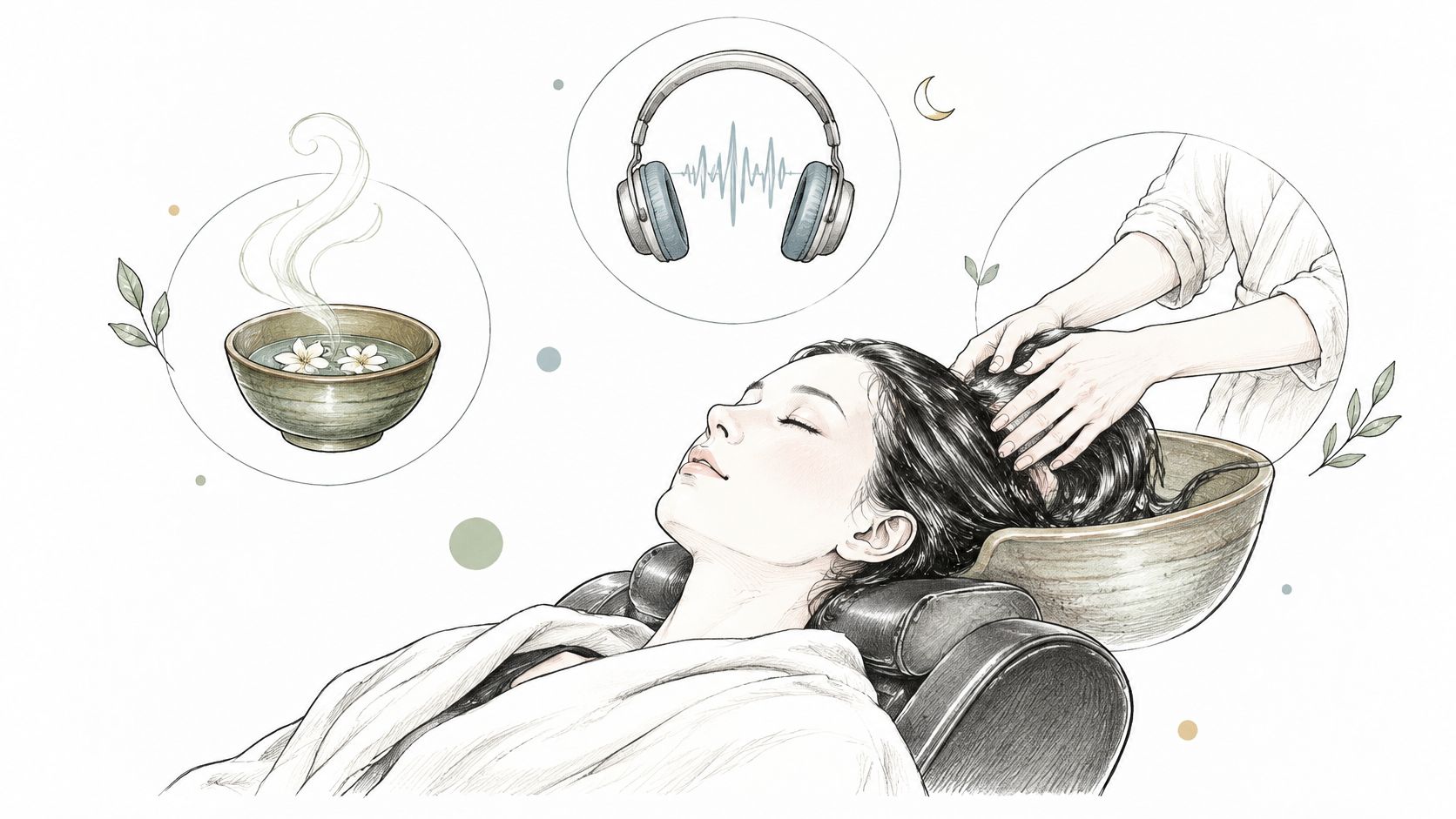
Scent is optional, not a treatment requirement
A systematic review of aromatherapy studies included five studies and 254 participants, but differences in oils, delivery methods, treatment duration, and outcome measurement prevented a recommendation for a routine clinical protocol. Some findings concerned stress, while anxiety findings were mixed. That doesn't establish an essential-oil treatment for migraine.
Choose fragrance according to tolerance, not a claim that a particular oil is necessary. If you're exploring an aromatherapy spa experience, distinguish enjoying a familiar scent from expecting it to change your migraine symptoms.
Sound and touch need their own settings
Sound belongs in the atmosphere category, not on a migraine treatment list. A soft background track might be welcome between attacks, while silence may be the better choice on another day. Singing bowls and guided audio shouldn't be treated as compulsory parts of relaxation.
For touch, start with gentle, even contact rather than searching for a painful spot to press. Firm trigger-point work is a separate intervention, not an automatic upgrade to scalp massage. There's no need to endure sharp pressure around your temples, jaw, or neck to make an appointment worthwhile.
- Keep what feels neutral or pleasant. Slow contact and a comfortable head position are reasonable starting points.
- Lower unnecessary stimulation. Request quieter audio, softer lighting, and less fragrance.
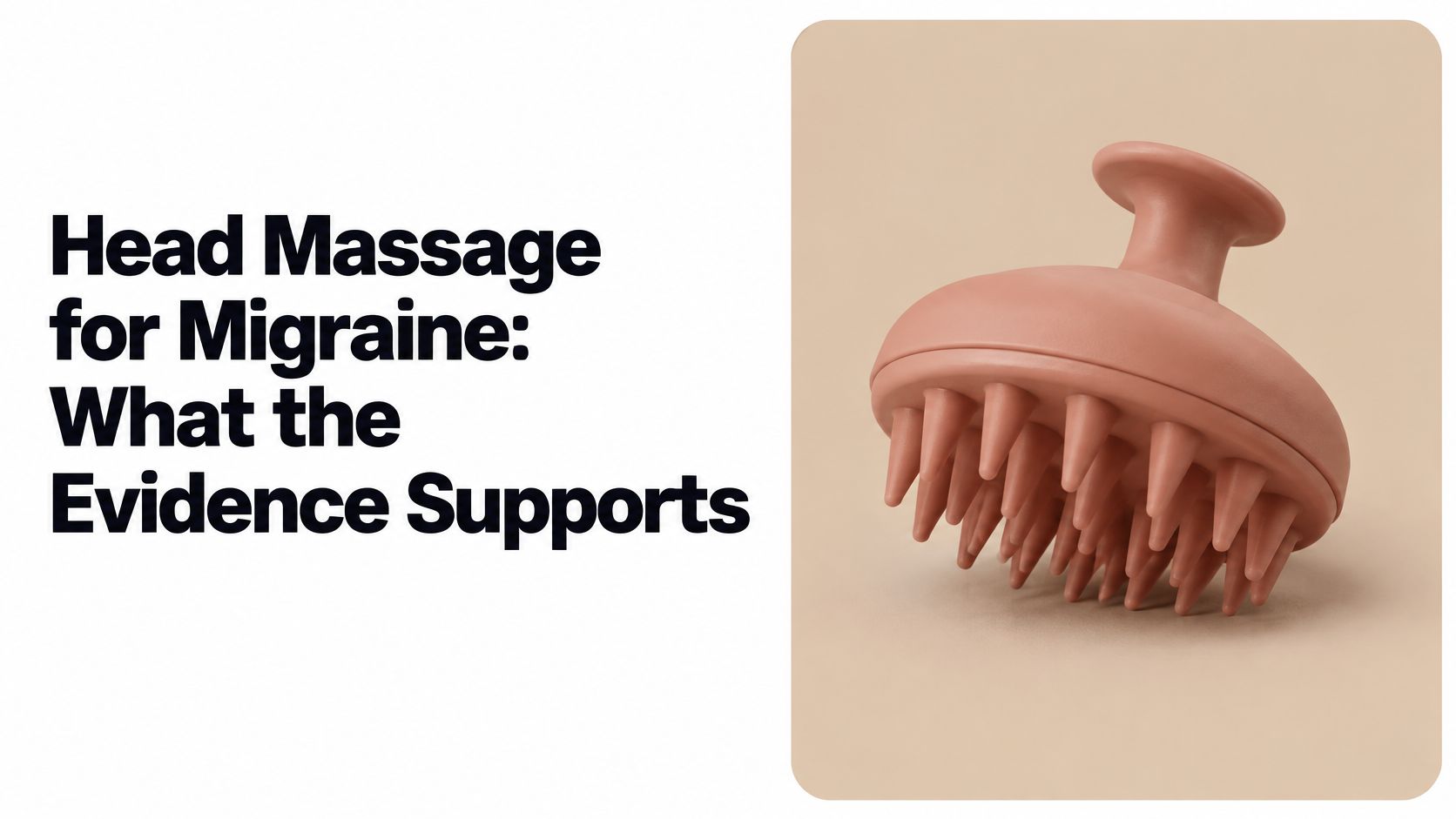
- Drop anything unwelcome. An oil, scalp brush, sound, or massage area can be something you don't want.
- Record the useful details. Note whether you preferred silence, lighter pressure, or no added scent.
You can change these preferences at each visit. The aim isn't to build tolerance for an elaborate ritual. It's to choose an experience you can comfortably receive.
How to Request a Gentle Session Safely
A useful request describes what you can tolerate, not the name of your condition alone. Saying that you have migraine is important, but it doesn't tell a practitioner whether you welcome scalp contact, dislike jaw work, or need to avoid fragrance.
Bring a written list if explaining preferences while settling into an appointment feels difficult. Keep the safety decision separate from choosing the enjoyable parts of the session.
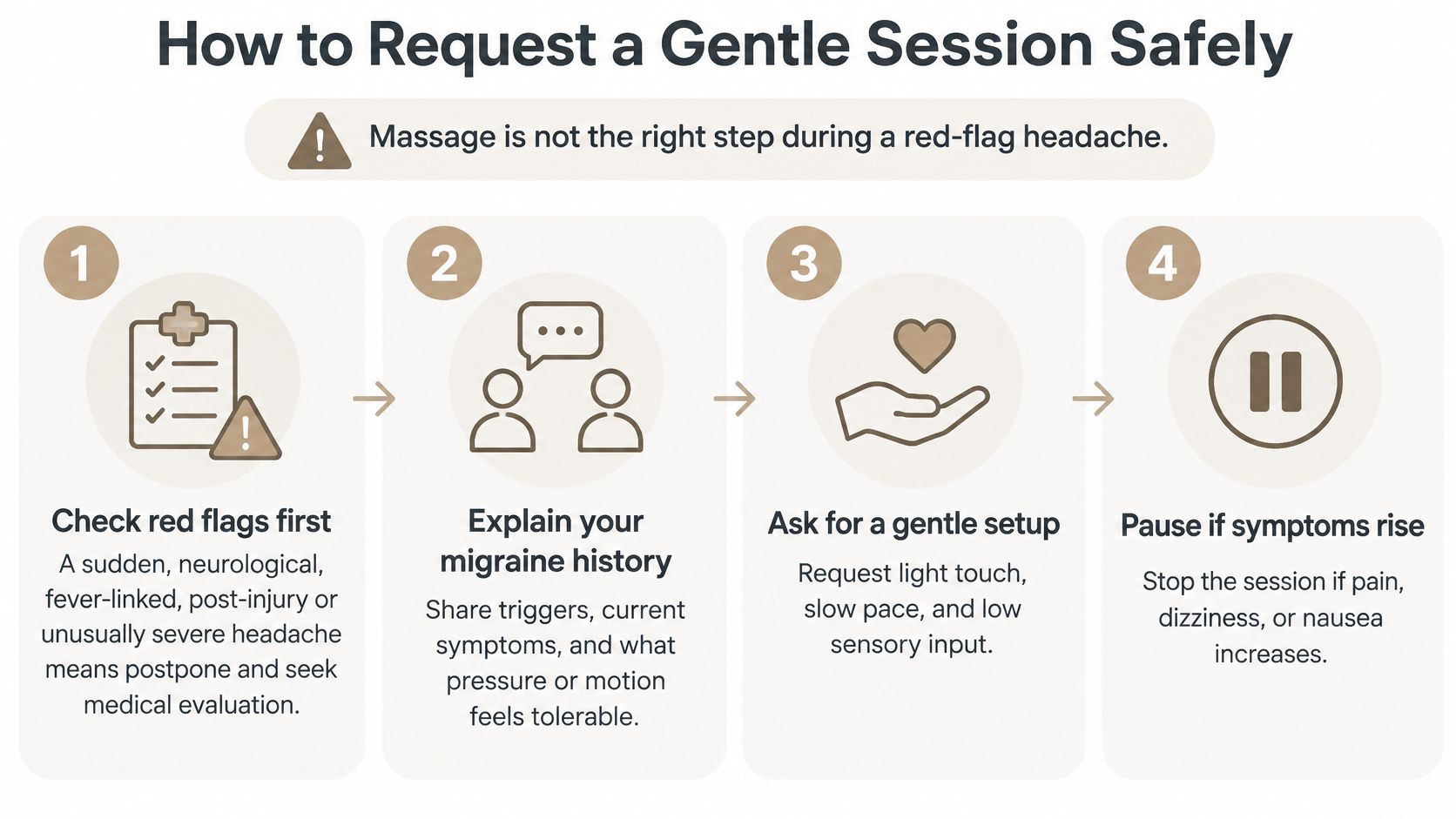
This visual summarizes the main checkpoints.
Before the appointment
Check for red flags first. Postpone and seek medical evaluation for a sudden, new neurological, fever-associated, post-injury, or unusually severe headache, because applying pressure is not the appropriate next step in those circumstances. Don't assume a headache is your usual migraine just because you've had migraine before.
Explain your migraine history and current symptoms. Tell the practitioner your familiar triggers, areas you don't want touched, and the medicines you rely on, because a useful intake needs more than a general request for relaxation. Keep medication decisions with your clinician rather than changing them for a spa visit.
Start lighter and agree on a stop signal. Ask for less pressure than you think you might want and choose a simple signal, such as raising your hand, because it's easier to increase comfortable contact than to undo an unpleasant start. Specify whether the temples, jaw, base of the skull, or neck should be avoided entirely.
Discuss scent before application. Ask what will be used, and request minimal fragrance or omission if scent is unwelcome, because a familiar label doesn't guarantee personal tolerance. If you have skin sensitivity, ask about testing the intended diluted product on the inner wrist the day before; a skin test doesn't predict whether its smell will provoke symptoms.
Set the lighting and sound deliberately. Request dimmed lighting and low audio before the treatment begins, because making these decisions early avoids having to negotiate them once you're reclined. Mention whether spoken meditation, music, running water, or singing-bowl tones are sounds you'd rather skip.
During and after the appointment
Speak up as soon as something feels wrong. Ask to pause or stop if pain, nausea, dizziness, or sensory discomfort increases, because completing a booked ritual isn't more important than your comfort. You don't need to wait for severe symptoms or explain why a particular sensation has become unpleasant.
Write down the response without rushing to a verdict. Note how you feel that evening and the next morning, then keep a record of migraine days over subsequent sessions, because a pleasant appointment and a change in attack patterns are different observations. Include other relevant changes, such as disrupted sleep or medication adjustments, for discussion with your clinician.
You can stop a relaxation session because you don't like it. You don't need a medical reason.
Errors to avoid
Don't book an active attack as an experiment in whether you can push through it. If symptoms develop before departure, contact the studio rather than assuming the appointment must go ahead.
Don't substitute a spa visit for prescribed care. Keep both preventive and acute medication decisions within your medical plan.
Don't use a single pleasant or unpleasant visit to make a broad medical conclusion. It can tell you whether that particular setup suited you, but it can't establish that massage treats migraine.
What a Private Head Spa Session Adds to Relaxation
Consider a hypothetical client arriving after a long workday with a tight neck, no active migraine symptoms, and a wish for quiet. They're looking for a defined period of rest, not someone to treat a headache.
A private setting gives that person room to state preferences without having to accommodate another guest's conversation, music choice, or pace.
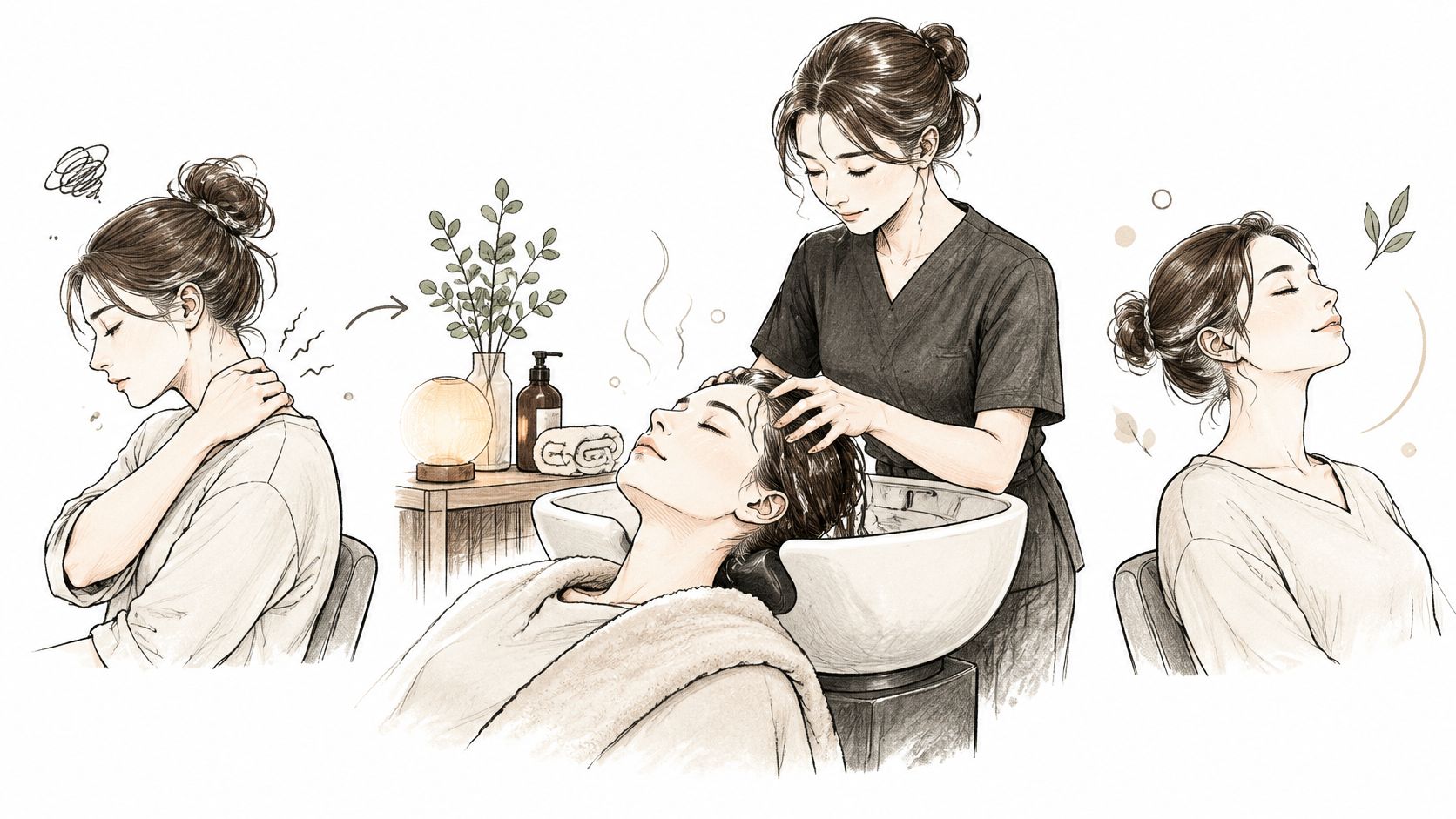
Privacy changes the experience
At our private studio, standard appointments serve one guest at a time. Compared with a shared treatment environment, that offers more personal space and a quieter conversation about what feels appropriate.
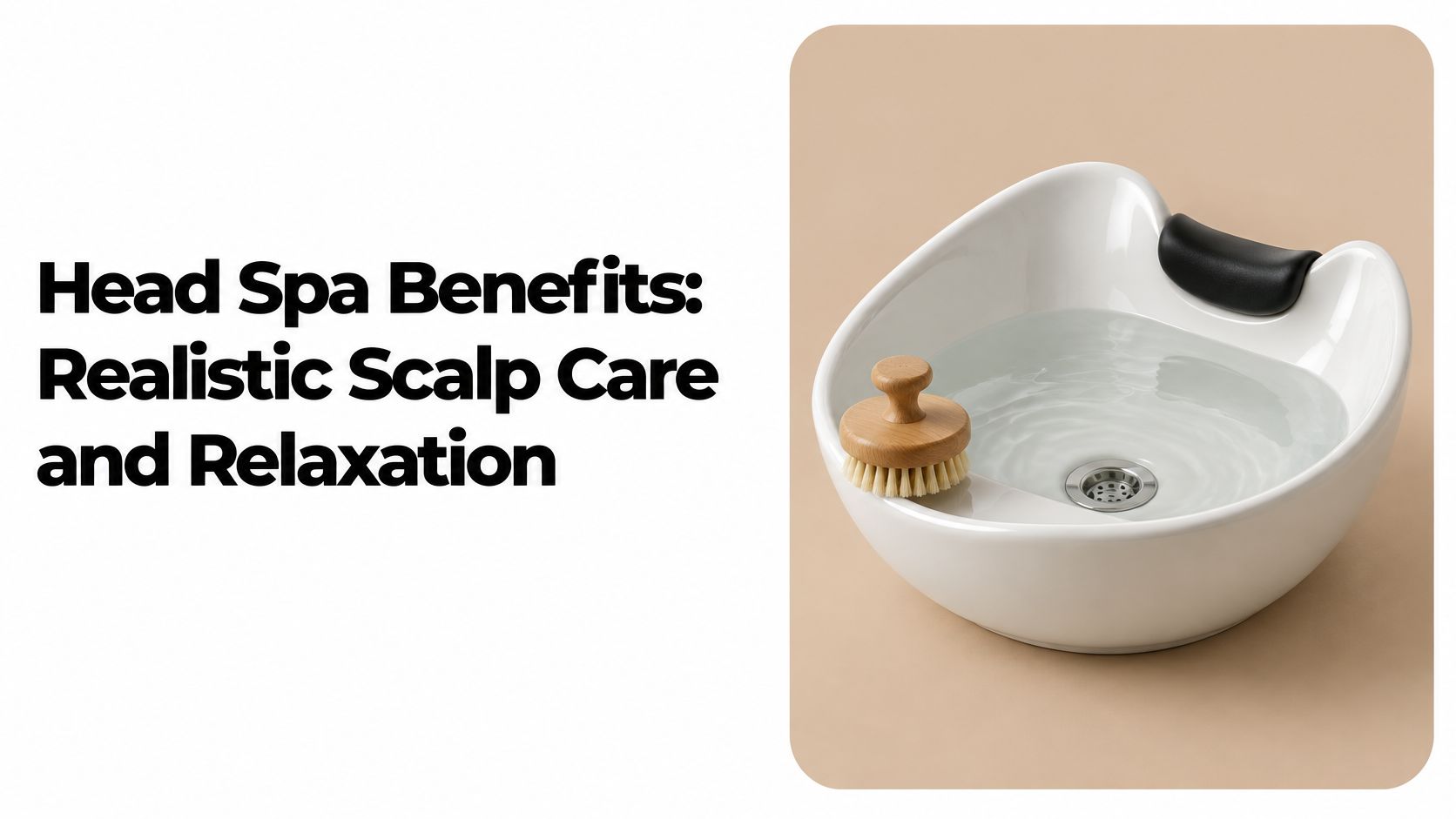
In this example, the client asks for low lighting, very soft sound, and gentle scalp contact. A brief conversation comes before the hands-on work, and the Japanese headspa bowl provides a place to position the head and neck during scalp care. The position should feel comfortable rather than something the client has to tolerate.
The practitioner proceeds at an unhurried pace. Guided breathing or meditation, scent, and sound follow the client's preferences, and a closing tea reflection provides an opportunity to sit still before leaving.
Atmosphere without medical promises
A Cedars-Sinai review of sound therapy describes studies as generally few, small, and inconsistent, with substantial variation and risk of bias in singing-bowl research. That's a reason to present sound as an optional atmosphere feature, not a medical intervention.
The same distinction applies to the broader hair-washing spa experience. Scalp care and an immersive setting can be enjoyable without being described as treatment for migraine.
Video can help you assess whether the pace and style look appealing.
The luxury here is privacy, time, and individual attention. None of those requires a claim that the appointment changes a neurological condition, and the client's medical plan stays in place.
Book a Gentle Session Within Your Migraine Plan
A gentle trial visit makes sense only if you want the experience itself. You don't need to expect fewer attacks to value private time, scalp care, or an appointment organized around your comfort.
If you're between attacks and no warning symptoms apply, start with a visit you can assess without pressure to commit. Keep your usual migraine diary, record whether the setup suited you, and discuss any apparent change in attack patterns with your clinician rather than attributing it automatically to the spa.
What we offer in Sherman Oaks
Inner You is a private, luxury head spa in Sherman Oaks, Los Angeles. We serve one guest at a time during standard appointments and perform our head spa treatments with a Japanese headspa bowl.
Our Inner Hour Head Spa Ritual is a one-hour treatment priced at $169. It includes aromatherapy, therapeutic head massage, a scalp brush cleanse with Oway botanical care, waterfall therapy, guided meditation, sound therapy, an express blow-dry, and tea reflection; a first visit comes with a $30 gift. The service name describes a spa ritual, not a migraine treatment.
Each session includes custom aromatherapy made with pure essential oils, intended as part of the relaxation experience. Tell us before booking if fragrance is a concern, and discuss whether a low-scent setup is suitable rather than assuming essential oils will agree with you.
Make the decision before the day arrives
When comparing a private head spa near you, consider how the environment fits your preferences, not whether the service advertises headache outcomes. Privacy can be especially valuable when you want to explain boundaries without feeling rushed or overheard.
- Preview the treatment style. Watch @inner_you_la on TikTok or @inner_you_la on Instagram to see treatments in video format.
- Share relevant preferences in advance. Tell us about migraine, scent sensitivity, pressure limits, and any areas you don't want touched.
- Reassess before leaving home. Skip the appointment if an active attack develops, and seek medical care rather than spa care for a red-flag headache.
A thoughtful booking leaves room to change your mind. The appropriate outcome to seek from a head spa is a comfortable experience, with no obligation to endure sensations or expect a medical result.
Inner You offers private Japanese head spa rituals focused on scalp care, personal attention, and a comfortable setting. If you're between attacks and considering relaxation alongside your existing migraine plan, visit Inner You to explore an appointment and share your sensory preferences before booking.