What Is Lymphatic Drainage Massage? a Gentle Guide
Curious about what is lymphatic drainage massage? Discover how this gentle technique works, what research shows, and when to see a doctor first.

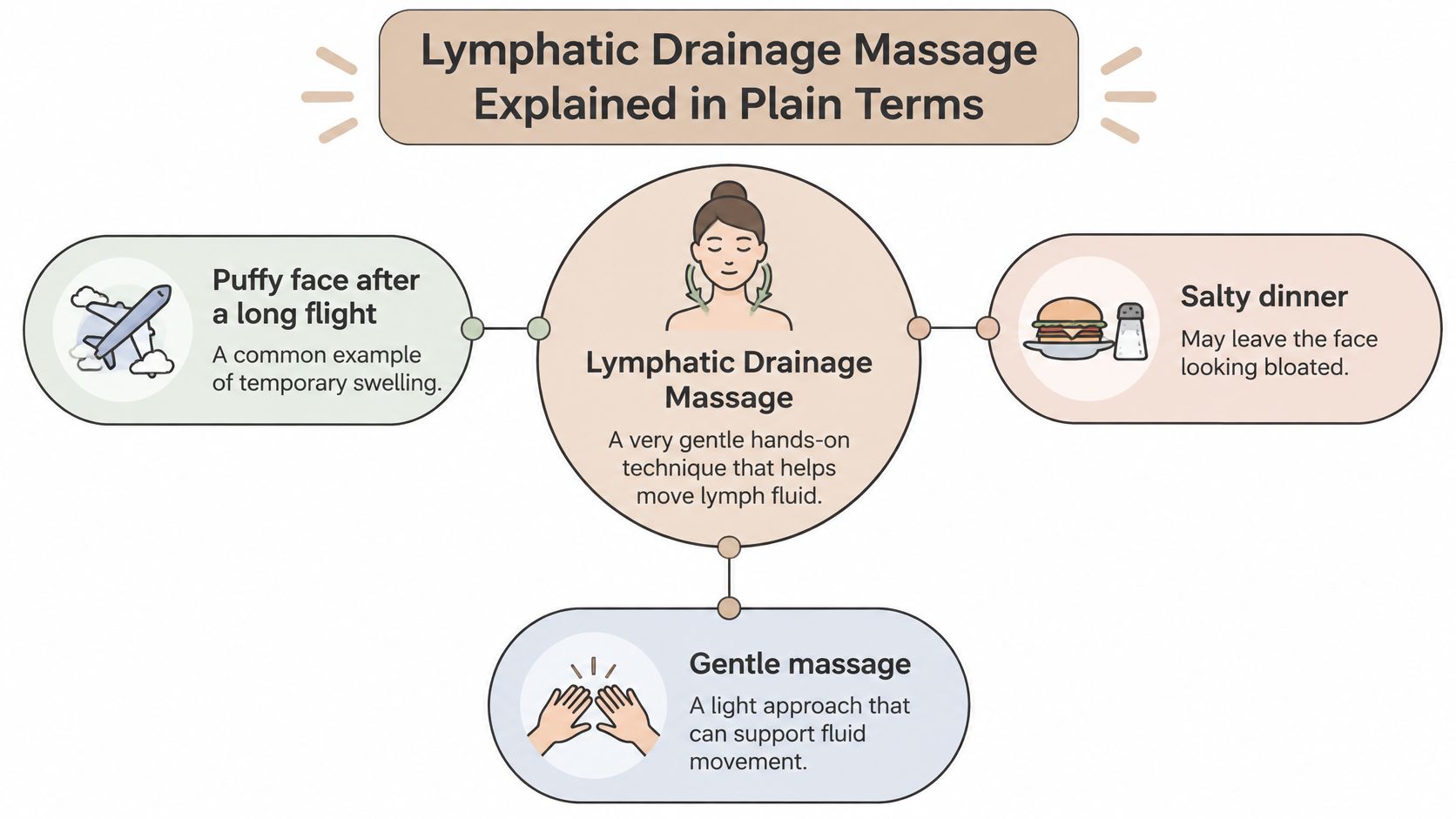
You wake up after a long flight or a salty dinner, look in the mirror, and notice your face looks puffier than usual. A gentle facial massage sounds appealing, but the descriptions online are confusing: one promises detox, another shows dramatic sculpting, and another discusses cancer rehabilitation.
So, what is lymphatic drainage massage, and which version are you considering? The most useful distinction is between a specialized clinical technique and a spa experience inspired by its gentle touch. They may share some movements, but they shouldn't come with the same expectations.
Lymphatic Drainage Massage Explained in Plain Terms
Swelling tells you fluid has pooled somewhere. It does not tell you why, or whether massage is the right response. Before comparing treatments, it helps to understand what that fluid is and where it normally goes.
Blood vessels deliver fluid to your tissues. Some of it remains between cells, where it is called interstitial fluid. Lymphatic vessels collect the excess, now called lymph, and carry it through a network that eventually returns it to the bloodstream.
According to Radiopaedia's lymphatic system overview, tissues generate approximately 8–12 liters of interstitial fluid daily, while about 4 liters of lymph returns to systemic circulation over 24 hours. These figures describe the body's normal fluid handling. A single massage does not remove a measured volume; the numbers show the scale of the system a gentle technique is meant to support.
A drainage network beneath the surface
The lymphatic system works like a neighborhood's storm-drain network. Water needs connected routes and open drains; pressing harder on the pavement moves nothing. Lymphatic massage follows the same logic, applying gentle pressure to guide fluid toward pathways that already function.
Manual lymphatic drainage, usually shortened to MLD, uses light, rhythmic, directional strokes over superficial lymphatic vessels. The method was developed in the twentieth century by Emil Vodder and is now taught in standardized training programs. Its named strokes include stationary circles, pumps, scoops, and rotary movements.
The illustration below sums up the idea.
The same term can describe different settings
You will encounter lymphatic drainage in several contexts:
- Clinical lymphedema care: a trained practitioner applies MLD within an individualized rehabilitation plan.
- Spa facial or body massage: a therapist incorporates lymphatic-style touch into a comfort-focused appointment.
- General wellness marketing: the term may appear alongside claims the technique cannot support.
These settings are not interchangeable. The most common source of disappointment with this massage is expecting clinical results from a spa appointment. A facial that leaves you rested is evidence of a pleasant hour, which is a perfectly good reason to book one. A cosmetic description on a menu, by itself, establishes nothing about a medical effect.
For familiar, temporary puffiness, the practical question is simpler: does a gentle, relaxing experience match what you want? Persistent or unexplained swelling is a different situation and belongs with a healthcare professional first.
Lymphatic drainage massage is a light, rhythmic, directional technique intended to support lymph-fluid movement, rather than a forceful massage or a detox treatment.
How It Differs From Relaxation and Deep Tissue Massage
Massage types compared by pressure, goal and setting
| Massage type | Pressure and movement | Main goal | Typical setting |
|---|---|---|---|
| Manual lymphatic drainage (MLD) | Very light, slow, rhythmic, skin-level | Support lymph flow and address swelling within appropriate care | Clinic or lymphedema program, sometimes spa |
| Spa lymphatic-style facial or body massage | Light to gentle, directional | Relaxation and the appearance of temporary puffiness | Day spa or private studio |
| Swedish relaxation massage | Light to medium, long flowing strokes | Relaxation and general ease | Spa or wellness centre |
| Deep tissue massage | Firm, deep, targeted pressure | Work on muscle tension and knots | Physiotherapy or sports massage |
Read across each row rather than choosing by the treatment name alone. Pressure, intended purpose, and setting tell you more than the word drainage on a menu.
If you want broad, flowing touch after a demanding week, Swedish-style relaxation massage may match that preference. If you want focused muscle work, deep tissue describes a different experience. Neither should be treated as a stronger version of MLD.
NHS Highland's lymphoedema guidance describes manual lymphatic drainage as gentle skin massage intended to redirect fluid toward healthy lymphatics without increasing capillary filtration. In plain language, the practitioner works with the skin and superficial pathways rather than pressing into muscle.
What a lymphatic-style session should feel like
A spa may blend directional facial strokes with other relaxation or sculpting-inspired movements. That doesn't automatically make the appointment equivalent to clinical MLD, which requires specific training and an appropriate treatment plan.
Useful markers include:
- Light skin-level pressure: You shouldn't need to brace yourself against forceful muscle work.
- Slow, rhythmic movement: Directional strokes follow an organized approach, sometimes involving areas near the neck and collarbone.
- Comfortable contact: Pain and bruising aren't signs that the technique is working better.
Say you book a facial because you prefer quiet, delicate touch. A therapist who uses vigorous kneading may be providing massage, but not the experience you expected from a lymphatic-style description. Tell them your pressure preference before treatment begins, and speak up if the contact becomes uncomfortable.
More pressure isn't a better lymphatic treatment. The superficial location of the vessels is precisely why this approach differs from firm muscle massage. Excessive compression can flatten those channels rather than improve movement through them.
How Gentle Touch Helps Lymph Move
A damp sponge offers a useful, if imperfect, analogy. A gentle squeeze can move water through its channels; crushing it can close the spaces you wanted the water to travel through. Living lymphatic vessels are more complex, but the comparison explains why force isn't the objective.
The illustration below shows the relationship between the lymphatic network and ordinary body movement.
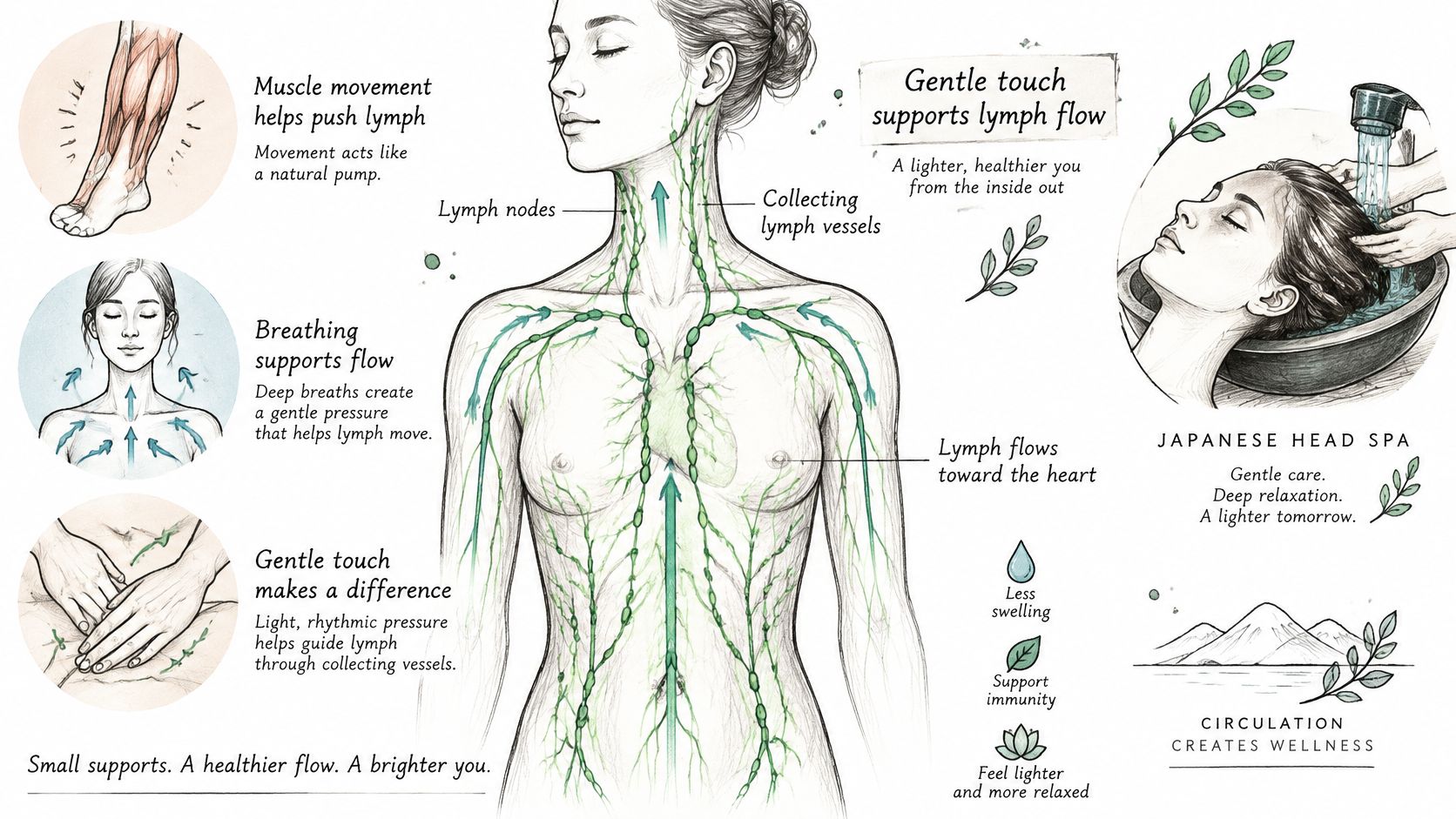
Unlike blood circulation, lymph circulation has no central heart-like pump. A physiology review available through PubMed Central explains that lymph flow relies on contractions within collecting vessels as well as outside forces, including skeletal-muscle movement, breathing, tissue movement, and compression.
Small pumping units and one-way valves
Collecting lymphatic vessels contain successive segments called lymphangions. Each segment has smooth muscle and inlet and outlet valves. Muscle contractions help propel fluid, while the valves help keep it moving in the intended direction.
Gentle skin deformation may assist movement into and through this network when the relevant pathways and valves remain sufficiently functional. That qualification matters: a hand movement can't be assumed to overcome every obstruction or damaged pathway.
The aim is also more specific than rubbing the swollen-looking spot. A trained practitioner considers where fluid can travel and may direct it toward functioning vessels elsewhere. The visible area isn't necessarily the starting point.
For an additional visual explanation of the anatomy, watch the following video.
Why the same touch won't produce the same response
The mechanism isn't a guarantee of a noticeable result. A plausible explanation of fluid movement tells us how a technique might act, not what every person will experience.
Several factors matter:
- Vessel health: Functional pathways and valves determine where fluid can go.
- The swelling itself: Its cause and extent affect whether massage is appropriate.
- Applied pressure: Contact must suit superficial structures rather than deep muscle.
- Practitioner skill: Direction, sequencing, and adaptation matter more than repeating a movement mechanically.
For chronic lymphedema, clinical care commonly combines MLD with compression, exercise, skin care, and education. The technique is therefore best understood as one potential part of a broader plan, not a stand-alone solution.
Core Hand Techniques and What Each Does
The names of lymphatic drainage movements can make the technique sound more complicated than it feels. Most describe small changes in hand position, skin stretch, and release, performed with deliberate rhythm.
A small upper-limb study archived by the University of Southampton describes a protocol using stationary circles, pump movements, and scoops, with proximal preparation followed by drainage toward axillary lymph nodes. It illustrates an important principle: the sequence matters alongside the movement.
Core lymphatic drainage movements and their purpose
| Technique | Movement | Purpose in a session |
|---|---|---|
| Stationary circles | Small circles held in place with fingertips or flat hand | Prepare the area for intended fluid movement |
| Pumps | Rhythmic pressing and releasing with the hand | Encourage movement toward lymph-node areas |
| Scoops | Gentle sweeping movements from the sides into the drainage path | Redirect fluid toward connected pathways |
| Rotary movements | Slow spiral motions over the skin | Adapt contact to contours, including areas around joints and the neck |
| Nodal clearing | Light stationary work over lymph-node areas before distal strokes | Prepare drainage toward the trunk |
Stationary circles don't mean rubbing rapidly in circles over the skin. The contact stays controlled while the practitioner gently stretches and releases the skin. Similarly, pumps aren't deep compressions, and scoops aren't vigorous sweeping strokes.
Nodal clearing is a technique label, not a claim that lymph nodes are clogged or need cleaning. It describes preparatory work around relevant drainage regions.
Why preparation comes before outward work
The following sequence explains a professional approach, not a self-treatment prescription. Clinical pathways can change after surgery or lymph-node treatment, so a generic diagram shouldn't replace individualized instruction.
- Prepare central drainage areas. Light stationary work near appropriate neck and trunk regions establishes the intended route.
- Progress from proximal to distal areas. Proximal means closer to the trunk; distal means farther away. Preparing closer regions first gives the later work a connected destination.
- Apply appropriate directional movements. Pumps, scoops, and rotary movements are selected for the area, while drainage strokes guide fluid toward the prepared pathways.
- Return toward central drainage regions. The practitioner completes the sequence along the planned route.
A common source of confusion is that treatment progression and stroke direction aren't identical. A therapist may progressively address areas farther from the trunk while directing individual drainage movements back toward an appropriate receiving area.
Practical rule: A recognizable technique name doesn't establish practitioner competence or guarantee a result.
Moving too quickly or applying firm pressure changes the character of the technique. Good practice depends on assessment, proper training, and the client's health, not just knowing how to imitate circles or scoops.
What Lymphatic Massage Can and Cannot Claim
The strongest clinical discussion concerns lymphedema, not cosmetic sculpting. Even within that setting, the findings require qualification rather than blanket promises.
A systematic review summarized by France's National Cancer Institute included 19 studies and 869 participants and reported conflicting findings: some studies found changes in limb volume, quality of life, or symptoms, while others found no additional benefit when MLD was added to complete decongestive therapy.
The review suggested possible usefulness in early post-surgical stages and mild lymphedema, with little demonstrated additional benefit for moderate-to-severe disease when full care was already provided. That describes findings within clinical care, not a promise about a spa appointment.
Common claims checked against the evidence
| Claim | What the evidence shows | Realistic expectation |
|---|---|---|
| Supports breast-cancer-related lymphedema | Mixed findings, including reported changes in limb volume and quality of life | A clinician may include MLD within complex decongestive therapy |
| Helps mild or early post-surgical swelling | Possible usefulness in selected early-stage cases | Follow the treating clinician's plan |
| Reduces temporary facial puffiness | Small physiological studies don't establish reliable facial cosmetic outcomes | A temporary appearance change is possible, without a proven duration |
| Detoxifies the body | No solid support for a massage-driven detox effect | No proven detox effect |
| Causes permanent fat loss | Not supported by the evidence | No lasting body-shaping promise |
| Speeds athletic recovery | Small, specialized studies don't establish broad recovery benefits | Comfort may be a goal, but faster recovery isn't assured |
A measured change isn't a lasting cosmetic result
A short-term measurement of lymph movement doesn't tell us whether someone's face will look different, how long any change will last, or whether repeat appointments are necessary. Those are separate questions requiring evidence about the actual outcome being advertised.
The same caution applies to exercise claims. A Sports Health study published in 2024 involved 16 trained men and assessed lactic-acid levels, walking, and jumping performance. Its narrow population and small sample don't justify promising faster recovery to a general spa customer.
Choose an experience, not a medical promise
The word detox often leaves out the most important detail: which substance is supposedly being removed, and how was that measured? A massage description doesn't establish that the liver and kidneys need assistance with their normal waste-handling roles.
Likewise, a temporary change in fluid-related appearance isn't fat loss. Terms such as sculpting should describe a style of cosmetic massage, not imply permanent anatomical change.
If your priority is restful touch rather than a specific swelling concern, our guide to hair and scalp massage describes another relaxation-focused experience.
You can value a massage for comfort and relaxation without needing it to detoxify, reshape, or medically treat your body.
When Swelling Needs a Doctor Before Any Massage
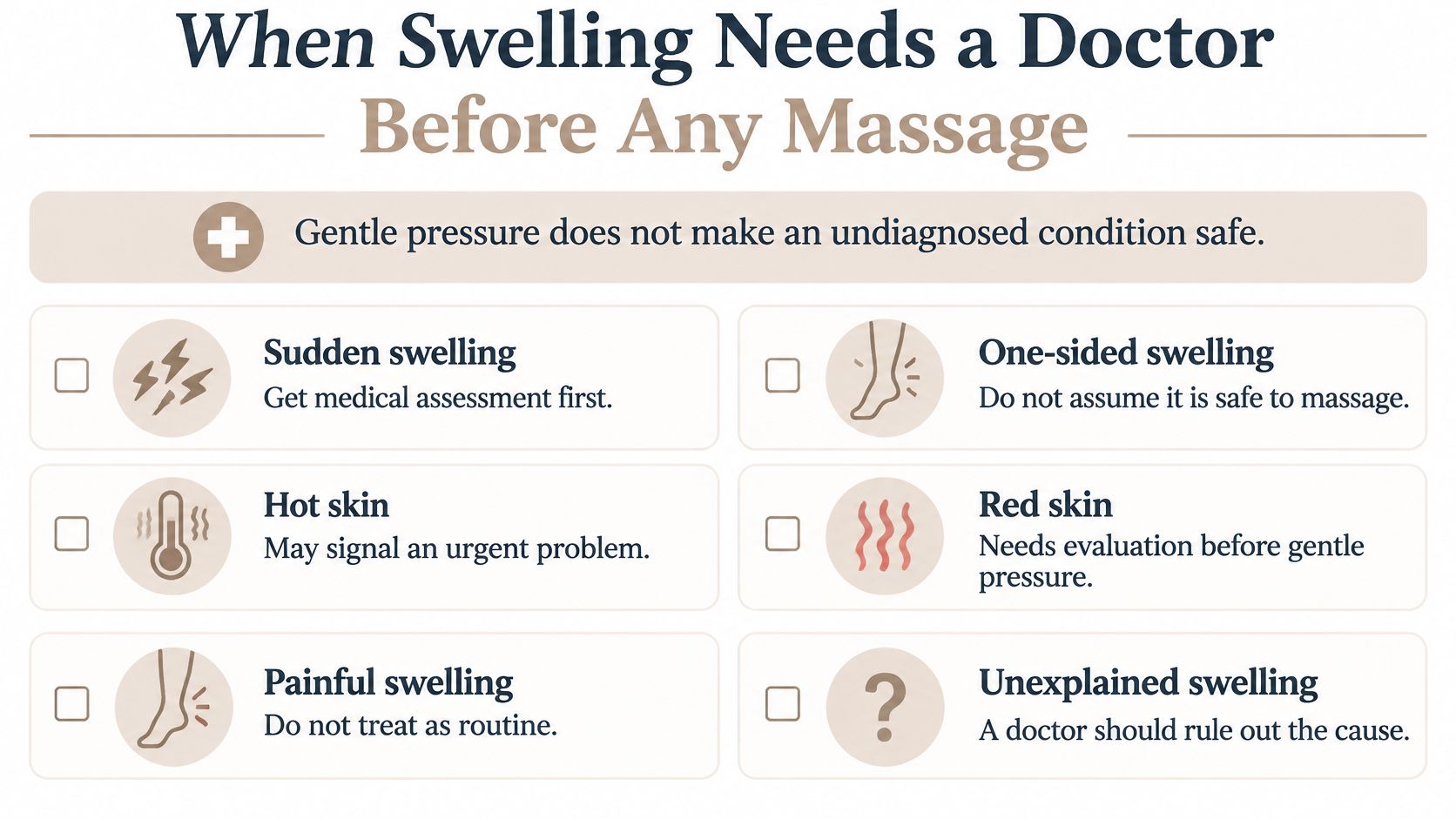
Sudden, one-sided, painful swelling should be assessed before massage. Hot or red skin makes it especially important not to assume that the problem is routine puffiness.
Gentle pressure doesn't make an undiagnosed condition safe. Infection, venous obstruction, and blood clots can present with swelling, and a spa therapist can't rule those causes out by touch.
Use this checklist to recognize reasons to pause before booking.
Conditions that need medical guidance
Ohio State's lymphatic drainage safety guidance advises avoiding treatment with fever or active infection and avoiding pressure over radiation-treated areas or known cancer sites. Its discussion also notes increased urination during the first 24–48 hours and a possible temporary blood-pressure rise in people with hypertension.
The Cleveland Clinic's treatment overview lists blood clots, cellulitis, deep-vein thrombosis, fever, heart disease, infection, kidney failure, and stroke among conditions in which lymphatic massage should be avoided. It also identifies fatigue, headache, and nausea as possible effects.
Before considering a session, flag the following:
- New or unexplained swelling: Include swelling that persists, worsens rapidly, affects one side, or feels painful.
- Infection symptoms: Fever, hot or red skin, and cellulitis aren't suitable for routine massage.
- Relevant medical history: Blood clots, cardiovascular conditions, kidney failure, or stroke warrant clinical guidance.
- Cancer treatment or radiation: The treating team should guide whether massage is appropriate and which areas must be avoided.
What screening should accomplish
Clinical MLD for lymphedema should follow evaluation and be provided by a trained lymphatic-drainage professional. A spa intake should also address health history, current symptoms, recent procedures, and reasons to defer treatment or obtain medical clearance.
Don't interpret feeling unwell afterward as evidence that toxins are leaving your body. Possible side effects aren't proof of effectiveness, and new or worsening symptoms deserve attention rather than reassurance based on a detox explanation.
Before booking, check: Is the swelling new? Is it one-sided? Is the cause unexplained? If any answer is yes, arrange a medical review before any massage.
Decide Whether a Private Session Fits Your Goals
Three readers arrive at this decision with different needs. One wants an hour of quiet after a demanding week. Another recognizes the soft puffiness that follows a salty meal or a short night of sleep. A third manages a diagnosed lymphatic condition and is sorting out where spa care ends and clinical treatment begins. The right choice depends on which of these sounds like you.
- You want time to unwind: A quiet, relaxation-focused appointment may fit without needing a visible cosmetic result.
- You're noticing familiar temporary puffiness: Gentle facial massage may appeal, provided there are no warning signs and you understand that appearance changes aren't guaranteed.
- You have diagnosed lymphedema or post-surgical swelling: Follow your clinician's advice rather than substituting a spa booking for rehabilitation.
Our guide to choosing lymphatic drainage massage near you can help you distinguish an appropriate setting from an appealing treatment label.
Privacy changes the experience, not the evidence
At Inner You in Sherman Oaks, Los Angeles, standard appointments serve one guest at a time. You have the treatment room to yourself rather than sharing a spa floor with other clients. For someone who prefers personal space, that difference may matter more than an ambitious before-and-after claim.
Sessions build sensory elements around the treatment itself: aromatherapy with essential oils, sound therapy, guided meditation, and a closing tea ritual. An attentive setting and an unhurried pace are real benefits. They aren't medical outcomes.
For massage-focused options, the Face Massage is a one-hour treatment at $159 that uses lymphatic drainage and sculpting techniques aimed at temporary puffiness and circulation. Body Massage runs one hour, with Deep Relaxation at $169, Honey at $179, and Lymphatic Drainage at $189. A Face + Body combination extends the visit to two hours for $329.
See the setting before deciding
A treatment room is hard to judge from a menu, so a few questions help before you commit: how the studio reviews your health history, what each session includes, and how the appointment time is paced. Reservations at Inner You are handled through Square or by text message, which gives you a natural chance to ask.
A comfortable setting improves the experience. Choose a private session because its style and pace suit your preferences, with the understanding that it's relaxation-focused spa care, not medical treatment.
Inner You offers private head spa, facial massage, and body massage experiences in Sherman Oaks, including gentle lymphatic-style options for guests seeking comfortable, restorative time to themselves. Visit Inner You to explore the treatments and choose an appointment that matches your relaxation goals.